FREEMASON OBJECTS IN THE COLLECTION OF DITSONG: NATIONAL MUSEUM OF CULTURAL HISTORY, PRETORIA
By: Jan van den Bos, Curator: DITSONG: National Museum of Cultural History
Freemasonry is among the world’s oldest and most powerful fraternal societies with a global membership exceeding six million. Freemasonry traces its origin to the stonemason guilds of the Middle Ages, which consisted of skilled craftsmen responsible for building palaces, castles and churches. During the 16th century, similar craft guilds such as carpenters, painters, tanners and candle makers emerged. Over time, craftsmen began to gather in lodges for social, intellectual and spiritual reasons.
Since 1723, lodges have been governed by a code of conduct focussing on the upliftment of individuals and of mankind. Tolerance, respect, kindness, charity, care and truth are regarded as core principles. Over time, the focus of freemasonry gradually shifted from its guilds-based origins to charitable work, particularly the support of orphans, the sick and the elderly.
Membership is non-political and open to individuals of all races and religions. A central requirement is belief in a Supreme Being – the creator or architect of the universe. Members are free to acknowledge their affiliation. However, intellectual affairs such as rituals, philosophy and debates during lodge gatherings remain private and are reserved for members only.
A member’s general dress code for a masonic event includes a dark suit, black shoes, and a white shirt and a tie. This uniformity fosters a sense of respect and unity while upholding tradition. As a symbol of honour and purity, a masonic apron is worn during the initiation of a new apprentice, the advancement to master mason and at formal lodge gatherings. The apron acquired symbolic significance that goes beyond its original utilitarian role in the craft guilds.
Symbols and hand gestures
Symbols comprise of customs and tools used by guild stone masters. (see Figures 1 and 2) Common symbols include the Eye of Providence, the gravel, the crossed keys, the square and compasses. The Eye of Providence symbolises God’s watchful eye or intervention over humanity. The gravel represents authority and is used by the lodge master, while the cross key denotes the treasurer of the lodge and symbolises secrecy. The square is a symbol of accuracy, precision, mortality and virtue, while the compass symbolises self-restraint and defines a balanced life.
To identify legitimate masonic visitors from non-masons, specific handshake gestures are used. The entered apprentice uses the “grip”, and the fellow craft men the “real grip.” The lodge and grand master handshake are distinguished by the use of the “master grip.”
During the Anglo-Boer War (1899-1902), an incident highlighted the significance of gestures attributed to masonic signs. A colonel in the Canadian Regiment, while walking near the Modder River one morning, was confronted by a man (a South African) who aimed a rifle at him. Unthinkingly the Colonel made a masonic sign when the South African, also a mason, threw his rifle to the ground and told the officer he was a member of the Pretoria Lodge. The two men then reportedly shook hands before returning to their respective camps.
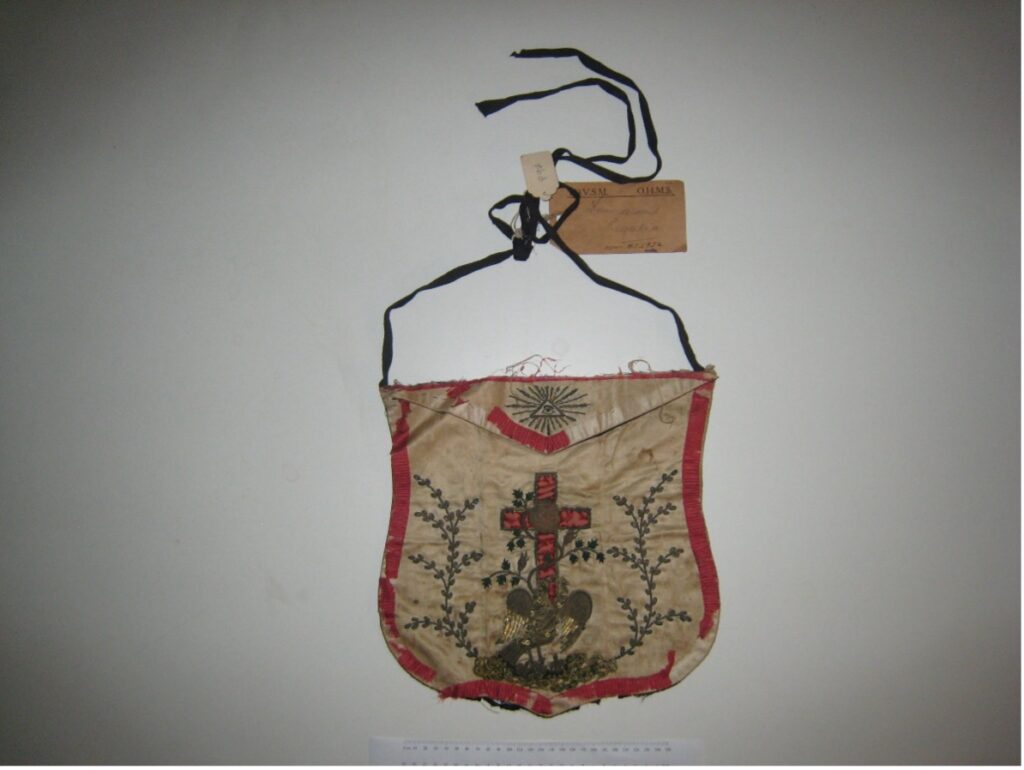
(Source: HG 5556, Flag collection, DNMCH)
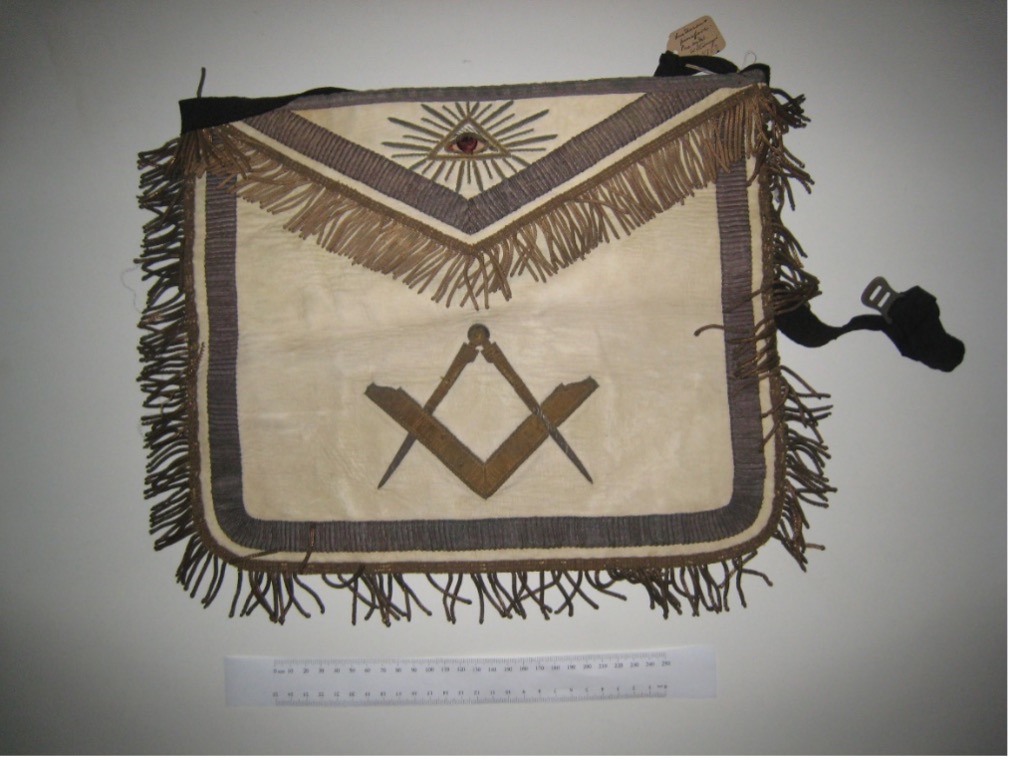
The apron symbolises value and tradition. (Source: HG 5763-12, Flag collection, DNMCH)
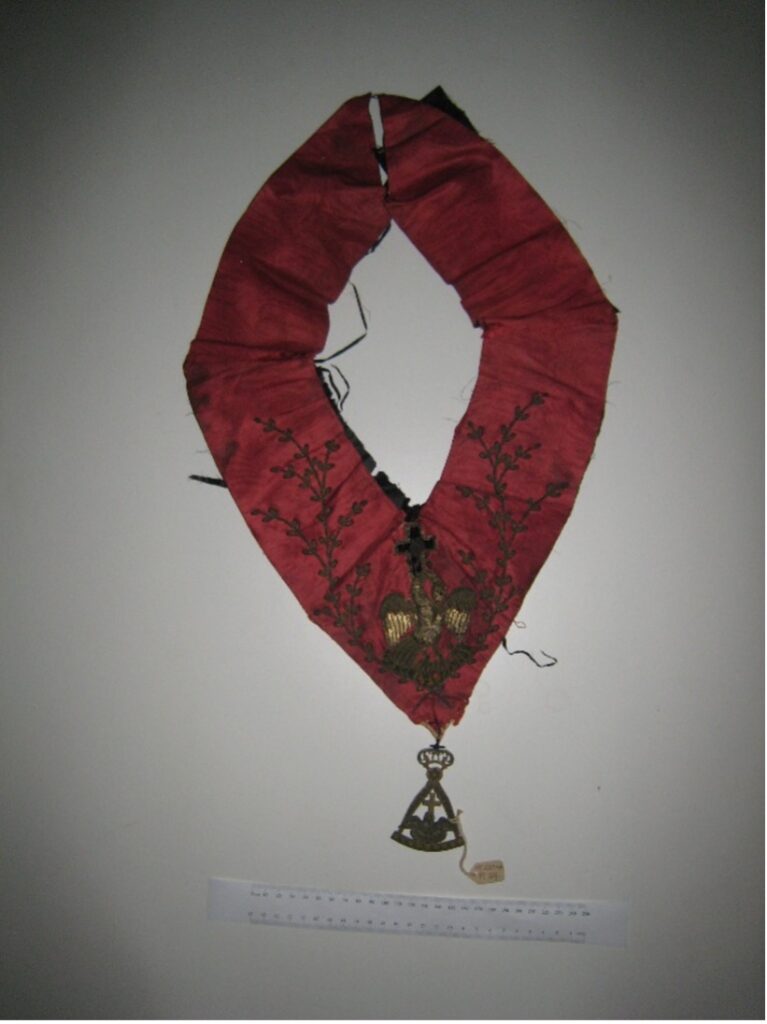
(Source: HG 5556, Flag collection, DNMCH)
Freemasonry in South Africa
The first Freemasonry United Grand Lodge was established in England in 1717, followed by Ireland (prior to 1725), Scotland (1736) and the Netherlands (1756). These jurisdictions shared authority over masonic affairs in South Africa until the establishment of the Grand Lodge of Southern Africa in 1961.
Freemasonry was introduced to the Cape through officials of the Dutch East Indian Company. Senior merchant Jacobus Cornelis Matthews Rademacher and Captain Abraham van der Weijde arrived at the Cape and convened a meeting on 24 April 1772, leading to the formation of the first South African lodge in South Africa. Abraham Chiron became the first Master of De Goede Hoop lodge. Other Dutch lodges were formed, namely De Afrikaan in 1798 and the De Goede Trouw in 1800.
Following the first British occupation of the Cape in 1795, the Dutch lodge, De Goede Trouw permitted British regiments to make use of its facility. The influx of English members into Dutch lodges created tensions, eventually leading to an inevitable split between English members. The Union (1811) became one of the first permanent, non-military lodges, exclusively for English members.
English lodges expanded into key trading centres of the eastern Cape including Fort Beaufort (1852) and Port Elizabeth (1857). In 1876, Lord Henry Carnarvon, Masonic Pro Grand Master and Secretary of State for the Colonies, divided most of the English lodges into three districts: Western and Eastern Cape and Griqualand West.
English and Scottish lodges dominated the Natal province. The first English lodges were established in Durban (1856), Grahamstown (1860) and King William’s Town (1861), while the District Grand Lodge of Natal (1885) was largely composed of Scottish members.
The Rising Star Lodge was one of the first lodges (1864) in the Free State capital of Bloemfontein, and included English, Scottish and Irish members. The Unie Lodge (1866) was predominantly composed of Dutch members, including prominent figures such as Government Secretary of the Republic, J.C. Nielen Marais, the Attorney-General, and President of the Orange Free State, Jan Brand.
Across the Vaal River, Dutch lodges were predominant. Although the first English lodge in Pretoria, the Transvaal was warranted in 1878, Dutch lodges remained dominant in the region until 1889. By 1898 the District Grand Master G. Richards reported to London that he controlled 24 lodges with a combined membership of 1,838. Dutch lodges were also established in Zeerust (1857) and Johannesburg (1887).
(Source: HKF 3864, Photograph collection, DNMCH)
Masonic lodges of the period were involved in community-oriented projects and duties. Their work included charity, education and relief support.
Local and international support
It was customary at the time for Freemasons to attend or participate in the laying of foundation stones for public buildings. They officiated for example the inauguration of the Scottish National Church in Somerset Road and the South African Museum and Library, both in the Cape.
Lodges provided financial support for the relief of widows, as well as for the education of poor children and orphans. Most lodges established dedicated funds to assist families in need. The Cape of Good Hope Dutch Lodge, under the watch-full eye of the Commission General and Grand Master, Jacob Abraham de Mist, outlined schemes for teacher training colleges, secondary schools and schools for girls. By 1809, there were three English and five free Dutch schools. A school for orphans and children of masons was established in the Cape in 1870. The Cape of Good Hope Lodge assisted in the education of needy children for periods of three years at a time. By the end of March 1892, the Education Fund reported that 14 boys and three girls – both children of masons and non-masons – were receiving assistance.
During the Anglo-Boer War, Freemasons interned in overseas camps such as St Helena and India reportedly received special treatment. General Ben Viljoen and Captain Versélewel de Witt Hamer, both held in St Helena, were able to attend masonic meetings of the Old Rock Lodge under the English Constitution in late 1902. General Viljoen told the Masons that he never expected to meet such friendship among both English and Afrikaans sides as a member of the Order. Freemasons and prisoners at St Helena were allowed extra parole. Gustav Preller, who was held in India, referred to special parole privileges and medical treatment.
The Commander-in-Chief for South Africa during the Anglo-Boer War, Field Marshal Lord Roberts, was a Senior Grand Warden of the United Grand Lodge of England. His Chief of Staff, General Lord Kitchener was Deputy Grand Master of Egypt and the Sudan. Lord Methuen, Sir George White and Redvers Buller were all leading Freemasons. Several leading South African soldiers and statesmen, such as General Louis Botha, Commandant General P.J. Joubert, General Piet Cronjé, General Ben Viljoen and Captain Danie Theron were members of the Masonic Order. In the aftermath of the war, masonic leaders raised and received funds both locally and internationally to assist masons and civilians in South Africa. Over £10, 000 was raised from the English Constitution, while the Netherlands contributed more than 10,000 Guilders during and after the war.
Wording of letter (see Figure 5)
Italian Masonry could not be indifferent to your heroic struggle, nor to the misery thereby entailed on thousands of widows and orphans. Though peace be now restored (may it long smile on you, knitting past foes into fast friends!) many will be in want, many appeal to world wide sympathies for relief.
Various Lodges, whose names are annexed, have gathered among brothers a small sum, here enclosed; accept it merely as a token of our fraternal desire to relief those who are in sorrow and want, innocent sufferers for their country. Our recent struggle for liberty and nationality makes us more akin to a people that cast into the scale life and energies for the same course.
And accept our small offering in the spirit by which it was engendered: a tribute of admiration for your heroic struggle, of sorrow for the sufferers it has entailed; a pledge of human brotherhood that binds men together, apart from all distinctions of race and nationality, when human suffering calls for human aid.
Believe me, personally and in the name of Italian Masonry, with sincere admiration.
To General Botha, Pretoria
From Grand Master: Grande Oriente D’Italia, Rome
30 May 1903
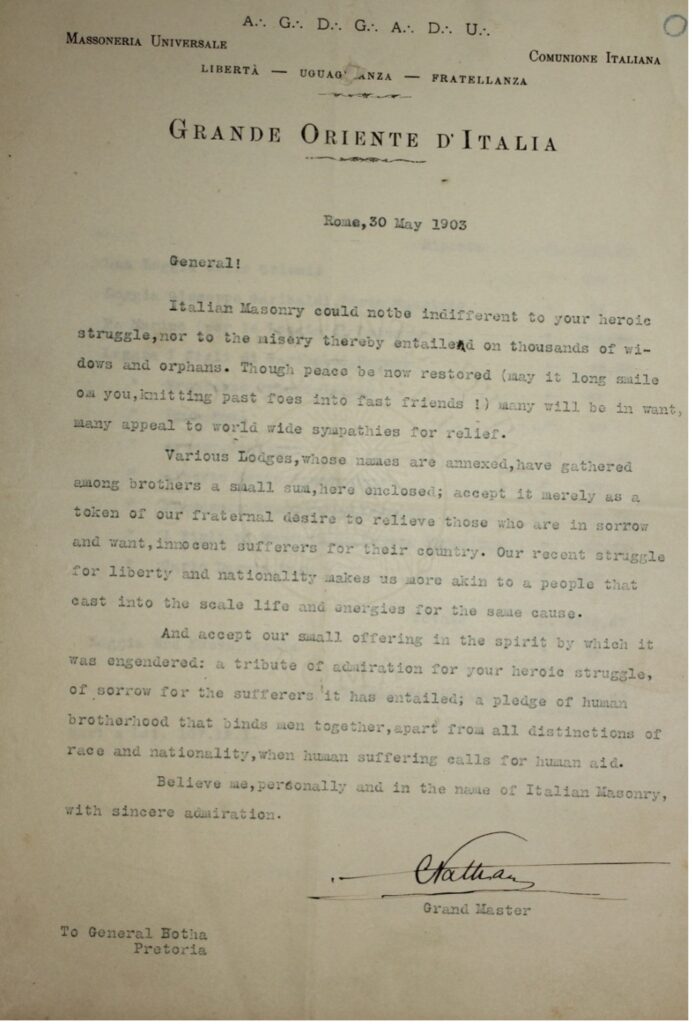
(Source: HG 4629, Document collection, DNMCH)
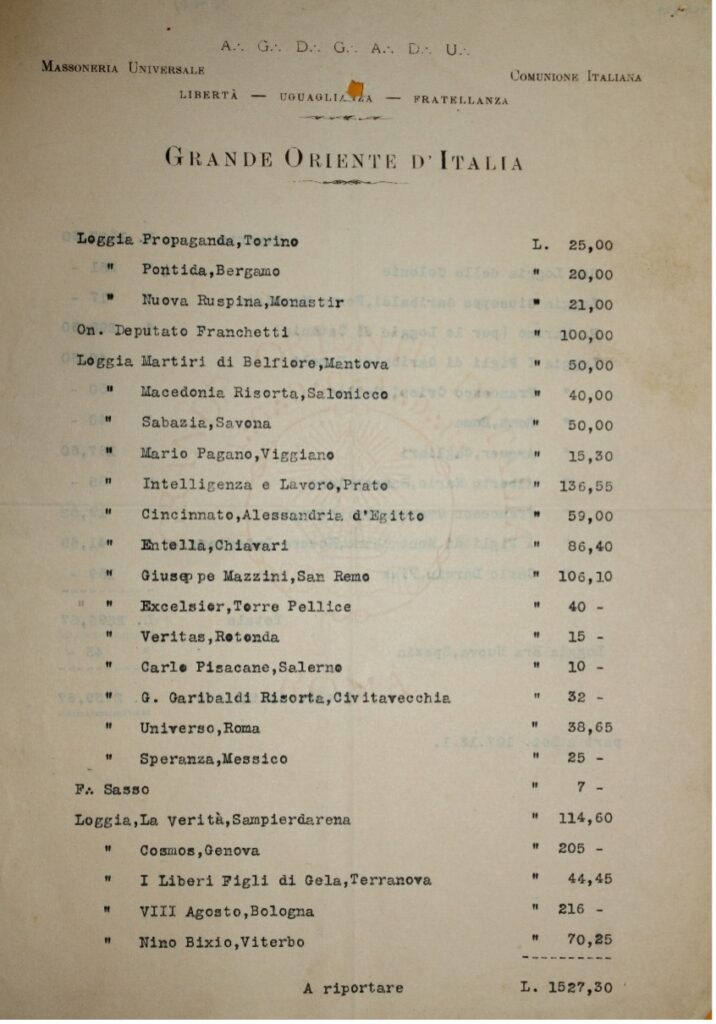
(Source: HG 4629, Document collection, DNMCH)
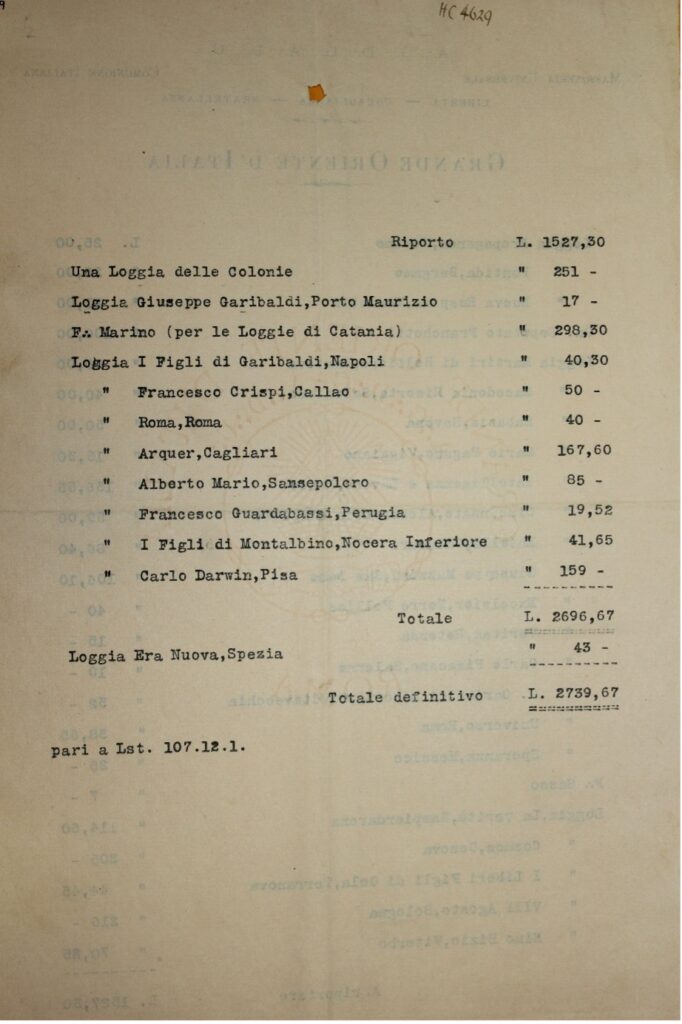
(Source: HG 4629, Document collection, DNMCH)
Conclusion
The Museum of Freemasonry in London, England, and the Freemasonry Museum in The Hague, the Netherlands, house some of the most extensive collections and displays of Masonic objects in the world. In South Africa, however, Freemasonry objects are dispersed across various museums. DITSONG: National Museum of Cultural History is privileged to hold a range of objects within the Louis Botha collection. (See Figures 5a, b and c) Louis Botha, a prominent (“high profile”) general and politician, also played a significant role as one of the key Freemason contact figures in the capital of South Africa.
Sources:
Cooper, A.A., The Freemasons of South Africa. Human & Rousseau, Cape Town, Pretoria, 1986.
HTTPS//: HistoryOLD – KZN Freemasonry