


G5/G6 HOWITZER AMMUNITION
By: David Rilley-Harris, Curator, DITSONG: National Museum of Military History (DNMMH)
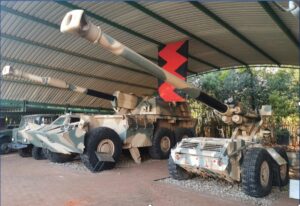
The G5 (right) and G6 (left) howitzers
(Picture: DITSONG: National Museum of Military History).
The South African military developed the G5 and G6 howitzers in the 1970s and 1980s to keep up with developments in weapons technology during the civil wars in Angola and Namibia. South Africa needed ranged artillery which could compete with Soviet Russian artillery in the region. In more recent times the G5 and G6 howitzers have been used in peacekeeping roles and have been exported to countries including the United Arab Emirates, Oman, and Malaysia. They are based on the original Canadian GC-45, and are famed for their range and accuracy. These abilities are largely due to developments in their ammunition which was pioneered by a Canadian scientist named Gerald Bull who founded the Space Research Corporation (SRC) in Belgium.
G5 and G6 howitzers can use the same set of 155 mm shells:
- High-explosive (HE) shells with impact, delay, or proximity fuses. They have a thinner shell with high fragmentation steel to spread shrapnel, and the explosives they are packed with is a mixture of trinitrotoluene (TNT) and hexogen (RDX).
- Armour-piercing (AP) shells to penetrate armour-plating on vehicles or buildings.
- Smoke shells to reduce visibility at the target location by creating a smokescreen. They are white, red, or blue, and can also be used for spotting or signalling.
- Illumination shells, which fall with the use of parachutes to illuminate an area at a luminosity of 1,65 million candelas. They can burn for at least ninety seconds.
- Cluster shells, or sub-munition, to spread smaller explosives over a wider area.
- White or red phosphorus shells as incendiary munitions which also act as a smokescreen. Phosphorus shells can also be used to provide a visible target for the howitzer with which to range its gun for accuracy.
- Pamphlet or propaganda shells carry leaflets of information to be quickly dropped over a distant location.
- Practice shells are used for training. They are similar in weight to live shells but with inert materials.
- It is rumoured that tactical nuclear shells were also considered for the G5 and G6 howitzers, but South Africa abandoned its nuclear weapons programme in the 1990s.
The three types of fuses used are the direct action or impact fuse, the radio proximity fuse, and the electronic time fuse which is set by hand before firing to detonate up to two hundred seconds after being fired. The full capability for the ammunition comes to fruition with the use of Precision-Guided Munitions (PGM) and Rocket-Assisted Projectiles (RAP), but perhaps most notably with the Swedish and SRC developed Base Bleed (BB) technology. The PGM shells make use of Global Positioning Satellite (GPS), high altitude balloon, or laser guidance to direct the shell, while RAP shells use rocket powered shells to extend the weapon’s range beyond the 50 km range of the BB shells.

The 155 mm shells and their propellant charges.
(Picture: DITSONG: National Museum of Military History).
The base bleed shells make use of a technological feature which reduces aeronautical drag extending the range of the shell by 30-40% when compared with the standard high-explosive shells. This puts the effective range of the howitzers at around 50 km depending on weather conditions, and it increases the accuracy. Much of the drag which slows down a fired artillery shell is caused by a pocket of low air pressure which forms behind the shell known as base drag. Base bleed shells contain a small propellant charge in the middle of the base of the shell which ignites shortly after the shell is fired. It is the heat from the main propellant charge in the shell which ignites the base bleed propellant and triggers the small motor therein. The base bleed propellant releases a flame for about one minute which is forced out of the base of the shell where it heats the low-pressure air behind the shell increasing the pressure thereby smoothing out the airflow around the shell and reducing turbulence and base drag. While they do not increase the range as much as RAP shells they can be applied to a wider variety of shells, and they are a simple design making base bleed shells far more manageable and affordable.

Base drag represented by the vacuum behind the airborne shell.

Standard shell (left) and base bleed shell (right)
The G6 howitzer requires five crew members to load and fire the shells. Most of the storage space in a G6 is in the back with propellant or charges also being stored in the triangular prism (triangle shaped cylinder) at the front of the G6. The driver and machine gunner work as ammunition handlers behind the stationary G6 where they feed shells and propellant into the rear of the vehicle and onto a feeding tray or conveyor belt. The feeding tray carries the shells and propellant to the flick rammer which is a mechanism for loading prepared shells into the breech of the gun barrel. The loader and breech operator stand inside the G6 near the breech using a rammer control box to manage the movement of the prepared shells into the barrel. The commander sits alongside the breech and controls the gun.
The G5 and G6 howitzers have a long future ahead with the promise of advancements in targeting technologies relying on improved base bleed technology, improved rocket propelled ammunition, improved fuses, and more complicated precision guided ammunition which can make course corrections during flight. Such smart munitions reduce collateral damage making them increasingly important in the peacekeeping role available to the G5 and G6 howitzers with the most important advances revolving around ammunition development. Finally, South Africa’s history with the Denel-made G5 and G6 howitzers provides the country with an opportunity for growing exports where the ammunition could potentially be developed and produced by local industry.


