AUSTRALOPITHECUS AFRICANUS SPECIMENS TM 1511 AND STS 60, INITIALLY ATTRIBUTED TO PLESIANTHROPUS TRANSVAALENSIS (BROOM, 1936)
By: Lazarus Kgasi, Junior Curator: Plio-Pleistocene Palaeontology, DITSONG: National Museum of Natural History
Specimens TM 1511 and Sts 60 are hominin fossils (representing distant relatives of humankind) from Sterkfontein (Member 4) in the Cradle of Humankind World Heritage Site, located 70 km southwest of Pretoria in South Africa. These fossils are estimated to be around 2.8 million years old. Representing one individual, they were discovered during lime-mining operations in 1936. Today, these specimens are curated in the Plio-Pleistocene Palaeontology section at the DITSONG: National Museum of Natural History (DNMNH) in Pretoria.
TM 1511 is a fragmented skull (Fig. 1) that includes the left maxilla with teeth, the orbital area, and most of the skull base. It was discovered by mine manager George Barlow and described by Dr Robert Broom in 1936 as the holotype of Plesianthropus transvaalensis. However, it is now attributed to Australopithecus africanus, the same species represented by “Mrs Ples” – an almost complete skull discovered at Sterkfontein in 1947.
Sts 60 is a partial brain endocast (Fig. 2), preserving most of the left side, with some parts of the frontal and temporal poles missing, but including the entire occipital pole as well as the posterior cerebellar lobe. The right side is represented only by the frontal lobe and a portion of the parietal lobe. Based on a reconstruction, the cranial capacity is estimated at 485 cubic centimetres.
Fig. 3 shows Sts 60 in association with the fragmented skull (TM 1511), which had been separated due to a dynamite blast during lime-mining operations.
Fig. 1. TM 1511 partial skull

Fig. 2. Sts 60 brain endocast
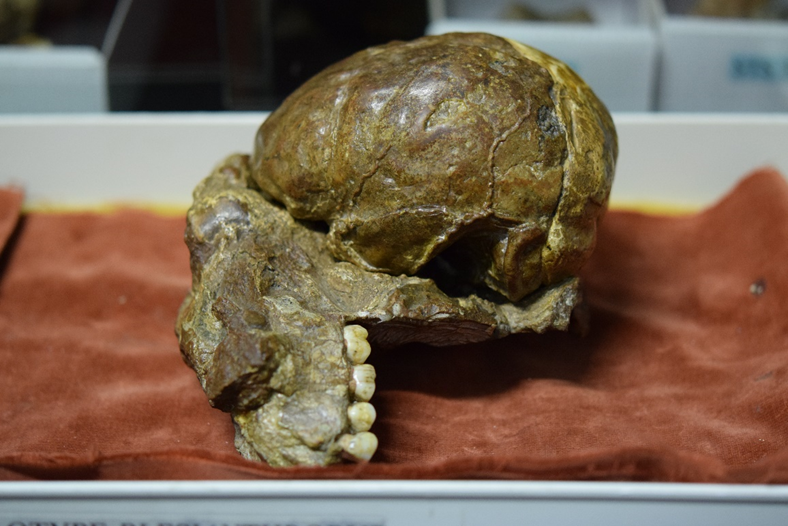
Fig. 3. Sts 60, a brain endocast, associated with the severely crushed cranium, TM 1511. Notably, the impression of blood vessels on the endocast is visible, offering a glimpse into the internal structure of the brain.