A DELIVERY FROM THE STATES A MESSENGER BOYS’ LONG JOURNEY TO PRETORIA
By: Jan van den Bos, Curator, DITSONG: National Museum of Cultural History
During the 1890s, the ‘messenger boy’ was a familiar figure, carrying both joyful and sorrowful news. The birth of a child or the death of a beloved one was usually brought by these messengers. On foot, horseback or bicycle, these boys – smartly dressed in blue uniforms and aged between the 10 and 18 – served as the era’s official communicators. They delivered handwritten or printed paper messages, packages and documents, while earning between 8 and 10 cents per delivery.
Western Union, one of New York’s largest telegraph companies, hired or employed boys to deliver messages both locally and abroad. Most deliveries were recorded by a messenger inspector in charge, whose records noted the messenger’s name, the delivery address, and any incidents that occurred. These records reveal incidents of reckless, unreliable boys who stole money, as well as accounts of proud, dependable boys who were often sent on urgent missions.

Figure 1: The entrance to the Western Union office, New York, ca. 1880 – at
the time, one of the largest telegraph companies in America
(Source: https://www.si.edu/object/archives/components/sova-nmah-ac-0205-ref10715 (Smithsonian Institution).
South Africa on the frontline
When South Africa was at war with Britain in 1899, a messenger boy from New York boarded an American ship bound for England. His special assignment eventually brought him to South Africa.
In the lead-up to war, the United States maintained neutral, although the American government’s unofficial support was with England. During the conflict (1899-1902), Britain purchased horses, mules and Winchester rifles with ammunition from the United States.
The Orange Free State (OFS) and the Zuid-Afrikaansche Republic (ZAR), the two Boer republics at war, had already formal diplomatic recognition from the USA since 1870. Yet, despite the American government’s increased British favouritism, it became evident that the majority of the American public sympathised with the Boers as the war progressed.
The Philadelphia initiative
Philadelphia newspapers – the Evening Bulletin and the Northern American – reported on 29 March 1900 that more than 28 000 Philadelphian schoolboys had signed an address within just two weeks. In this address, the boys sympathised with the South African people and admired the courage of President Paul Kruger. Edwin A. Valkenberg, the editor of the Northern American and the driving force behind the messenger boy’s delivery assignment, played a significant role in Philadelphia’s sense of “independence” from British influence.
Messenger boy No. 1 534 – 16-year-old James Francis (Jimmy) Smith of Brooklyn, New York, and an employee of the American District Telegraph Company in Philadelphia – was chosen to deliver this message to President Kruger in Pretoria. Jimmy was selected from more than 1 900 messenger boys for his honesty, trustworthiness and determination.
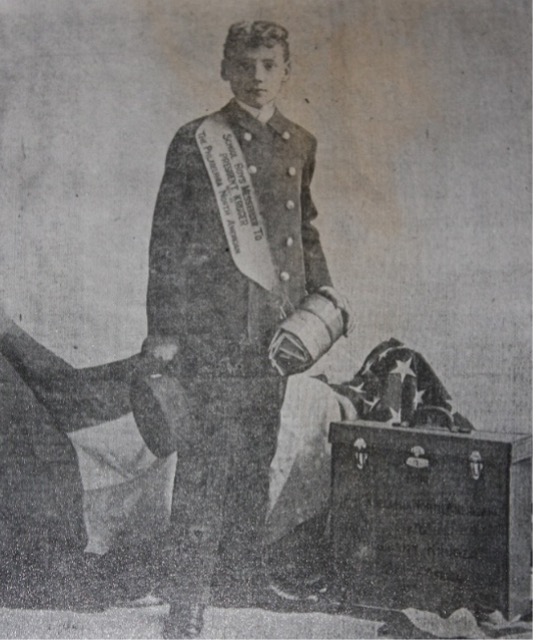
Figure 2: Messenger No. 1 534, James Francis (Jimmy) Smith
(Source: Kr 238-4, DITSONG: Kruger Museum, Kruger collection).
The city of Philadelphia honoured Jimmy at a special event held in the hall of the Academy of Music. Many parents and children attended the function. A large number gathered in the garden in front of the entrance, unable to find space indoors. Those outside listened to music and poems, while those inside witnessed the ceremonial handover of the message and the signatures. Jimmy left with a leather bag slung over his shoulder. In his hand he held a locally embroidered Vierkleur (the Transvaal four-colour flag) (See Figure 2).
The following day, a guard of honour consisting of eight schoolboys followed Jimmy Smith and Mr Hugh Sutherland as they departed for New York harbour to embark on the American ship the St Louis. Mr Sutherland, a member of the editorial board of the North American newspaper, accompanied Jimmy on this adventure.
The voyage
On 9 April 1900, the St Louis departed for Southampton, England. Upon arrival, the two delegates went ashore and transferred to a French vessel that carried them to Le Havre, a port in northern France. From there, a train took them to The Hague in the Netherlands, where they first met Queen Wilhelmina, followed by a meeting with Dr W.J. Leyds, the State Secretary of the ZAR. When Jimmy explained the purpose of their mission both showed great interest. After a brief visit to the Netherlands Jimmy and Mr Sutherland departed via the Suez Canal for South Africa. They arrived at Delagoa Bay, Lourenço Marques (present-day Maputo) on 25 May 1900. From there, a train took them to Pretoria, despite reports of a British advance on the capital.
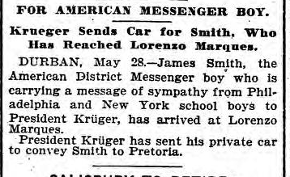
Figure 3: The New York Times of 28 May 1900 reports on the arrival of Jimmy Smith at Lourenço Marques (25 May 1900) (Source: https://www.nytimes.com/sitemap/1900/05/29/).
The reception and delivery
Jimmy Smith and Mr Sutherland arrived in Pretoria on 28 May 1900. A meeting between President Kruger and Jimmy was scheduled for the following day in a private room at the Raadsaal on Church Square. At two o’clock, the President interrupted the last War Council meeting before leaving the capital to personally receive Jimmy, who delivered the message, the signatures and the ZAR flag.
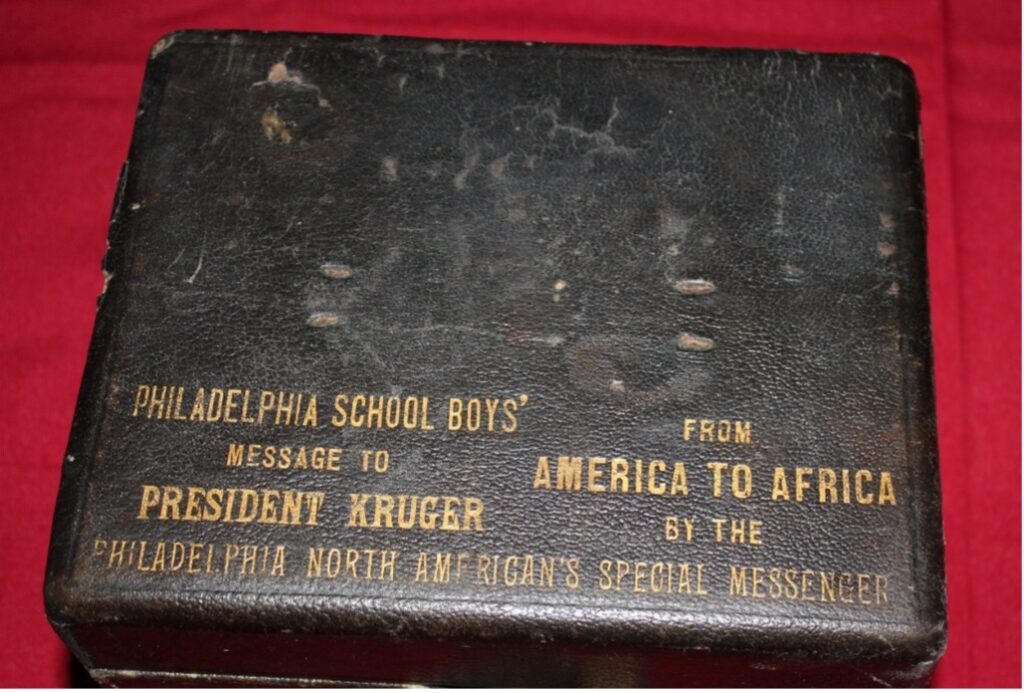
(Source: Kr 239-1, DITSONG: Kruger Museum, Kruger collection).
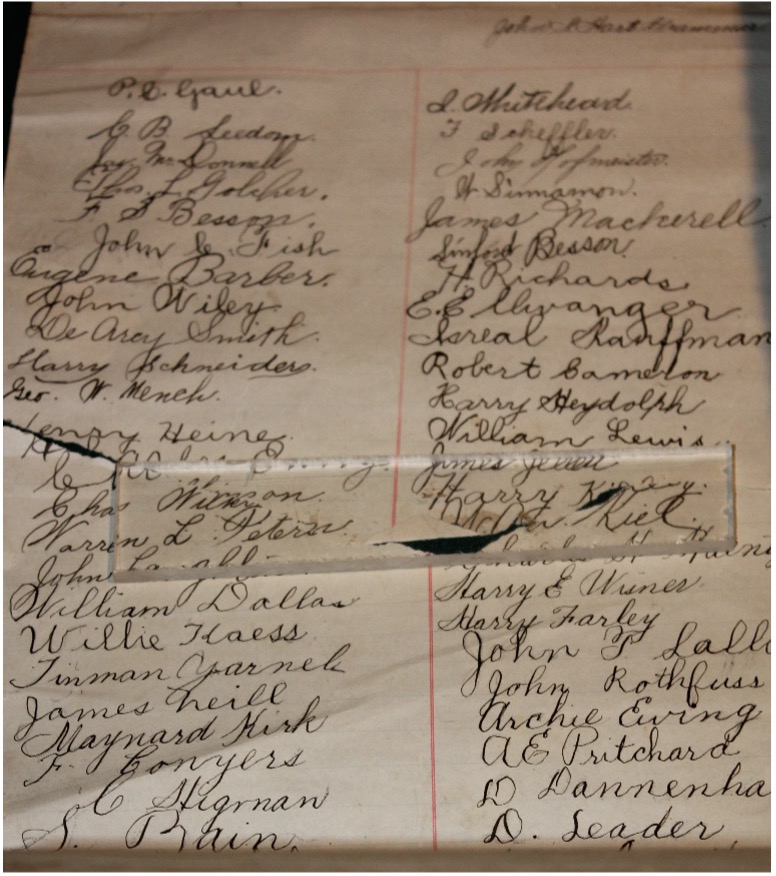
(Source: Kr 239-2, DITSONG: Kruger Museum, Kruger collection).
Jimmy recalled:
“I was received by the President in the Executive Offices of the Raadsaal. Through the open windows I could distinctly hear the booming of the British guns in the distance. There was an impressive silence in the chamber as the venerable President of the doomed Republic bent forward to receive the package containing the 28 000 names and the message from the schoolboys of Philadelphia. As the President took the message Secretary Reitz (member of the war council) exclaimed “Ave Ceaser morituri te salutamus. (Ceaser greets those about to die). This reference to the United States and the message of sympathy from America to the president of a dying republic, profoundly moved every one present. Tears glistened in the President’s eyes. I there upon read the message which Secretary Reitz translated. President Kruger’s reply was grave and courteous. He tendered his hearty thanks to the schoolboys of Philadelphia and said it gave him new courage to continue the struggle in the defense of the freedom of the country and its people. He concluded by saying that he would ever cherish the memory of that mementoes occasion.”
The message reads:
“We the undersigned students of the Public schools of Philadelphia, the city where our own forefathers enlisted in their splendid and successful struggle against English oppression, desire to express to you and the South African Republic their admiration for the genius courage that has checked English invasion of the Transvaal and the undersigned extend their most earnest wishes that in the end the South African Republic their admiration for the genius courage that has checked English invasion of the Transvaal and the undersigned extend their most earnest wishes that in the end the South African will triumph over England in a war in which the Boer cause is noble, the English cause is noble, the English cause unjust.”

(Source: Kr 238-1, DITSONG: Kruger Museum, Kruger collection).
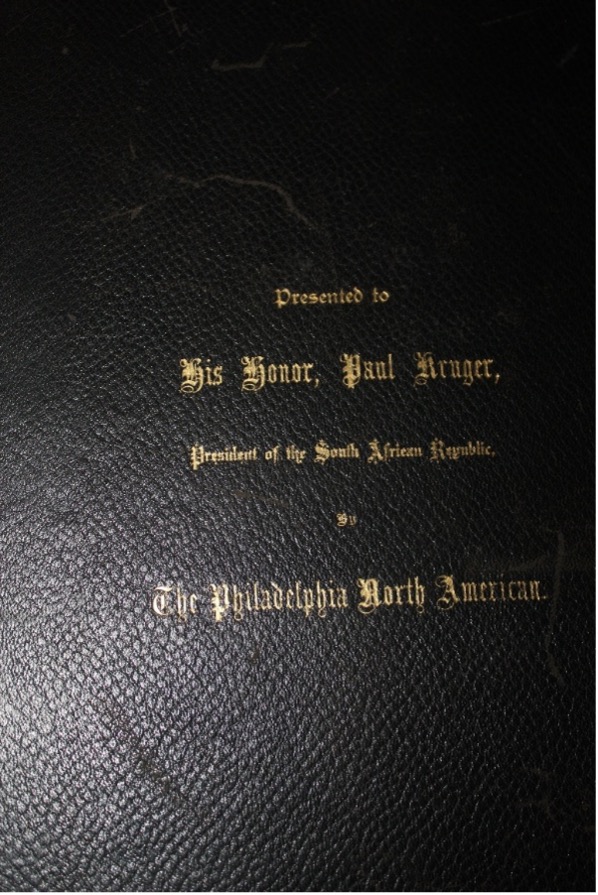
(Source: Kr 238-2, DITSONG: Kruger Museum, Kruger collection).
The President left the city that same afternoon for Machadodorp. When the British occupied Pretoria on 5 June 1900, an excited Jimmy wandered along the marching British column carrying an American flag, while the British commander-in-chief, Lord Roberts, and his army prepared to hoist the Union Jack. Once the British learned of Jimmy’s mission, he became very unpopular with them. Jimmy and Mr Sutherland were taken into custody, but through the intervention of the American consul-general, Mr Heys, they were released after six weeks. They arrived in New York on 16 September 1900 abroad the ship Kinfaus Castle. In total, Jimmy travelled over 35 400 kilometres, at a travelling cost far exceeding the usual fee for a messenger boy.
DITSONG: Kruger Museum preserves and displays the objects associated with Messenger Boy No.1 534, Jimmy Smith, and President Kruger. This tangible evidence ensures that this remarkable historical event continues to be remembered and appreciated by visitors.
Note
Jimmy Smith remained in the telegraph service for another year or two before joining the New York Police Force and was quickly promoted to the rank of sergeant because of his diligence. During the First World War, Jimmy joined the 304th Battalion Tank Corps. After the war, he again applied for a position in the New York Police Force and became one of New York’s finest detectives in the 110th Squadron. James Francis Smith passed away at the age of 56.
The embroidered Transvaal Vierkleur (four-colour) flag that Jimmy had handed to President Kruger in Pretoria remained with the President aboard the Dutch ship, the Gelderland. During a special reception on 19 November 1900, the Transvaal and the Dutch (Netherlands) flags were displayed beside a portrait of Queen Wilhelmina in the dining cabin, in honour of the Queen, who had offered Kruger a safe journey to Europe.
It appears, however, that the Transvaal flag never reached Pretoria. Perhaps the crew forgot to remove the hanging flags from the cabinet when the President left the ship. It remains a mystery.
The USA flag that Jimmy carried through the streets of Pretoria when the British forces entered on 5 June 1900 also disappeared. (See Figure 2).
Sources
De Jong, R.C., President Kruger se reis met die Gelderland, in SA Tydskrif vir Kultuurgeskiedenis 2(4), 1988.
Deppermann, W.H. and Margaret, Schoolboy saga. It was only a newspaper promotion, but it hangs up a new record for messenger no 1534, in Coronet 5(1-5), n.y.
https://journals.ufs (Changuion, L., American Policy concerning the Anglo-Boer War (1899-1902)
https://www.si.edu/object/archives/components/sova-nmah-ac-0205-ref10715 (Smithsonian Institution).
Van Wyk, E, Kinderhulde aan President Kruger. Amerikaanse seun dra `n boodskap halfpad om die wêreld, in Die Huisgenoot XXIX (1188), 29 Desember 1944.