MASSOSPONDYLUS
By Heidi Fourie: Curator: DITSONG NATIONAL MUSEUM OF NATURAL HISTORY
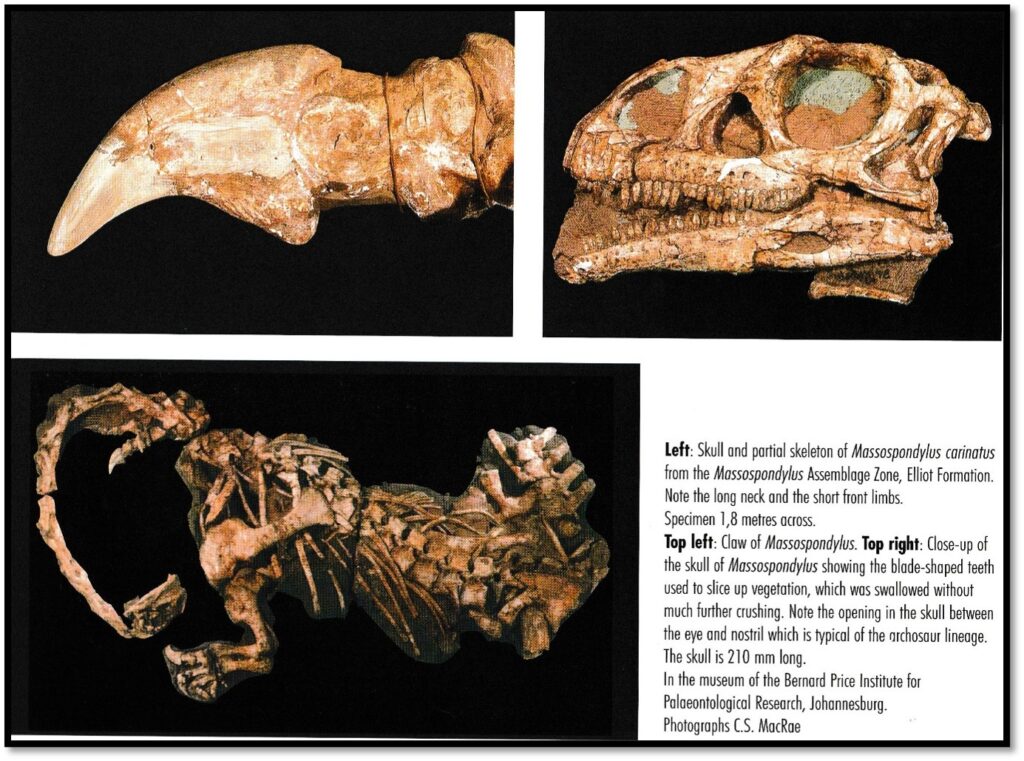
Massospondylus is a prosauropod dinosaur, a group of saurischian dinosaurs with lizard hips. It lived during the Late Triassic and Early Jurassic. It stood 4 m tall with an unusually small head.
Long tails help to counterbalance the front part of the body over the hips. The hindlimbs are relatively sturdy and were evidently well-designed to carry the bulk of the weight of the animal when walking. The feet were quite broad with four well-developed toes and the rudimentary remains of the fifth. The forelimbs and shoulders, however, were also remarkably well-developed. The shoulders are stout and the arms relatively long and were evidently capable of touching or resting on the ground with ease. The curious hands have outer two fingers that are quite small and slender, lacking claws, while the first finger is prominently large and has a sharply-curved claw.
The presence of serrated teeth in prosauropods suggests a herbivorous diet. A gastric mill, an area where pebbles would grind the plant material, have been found in Massospondylus. Their long necks allowed them to reach and feed on high foliage.
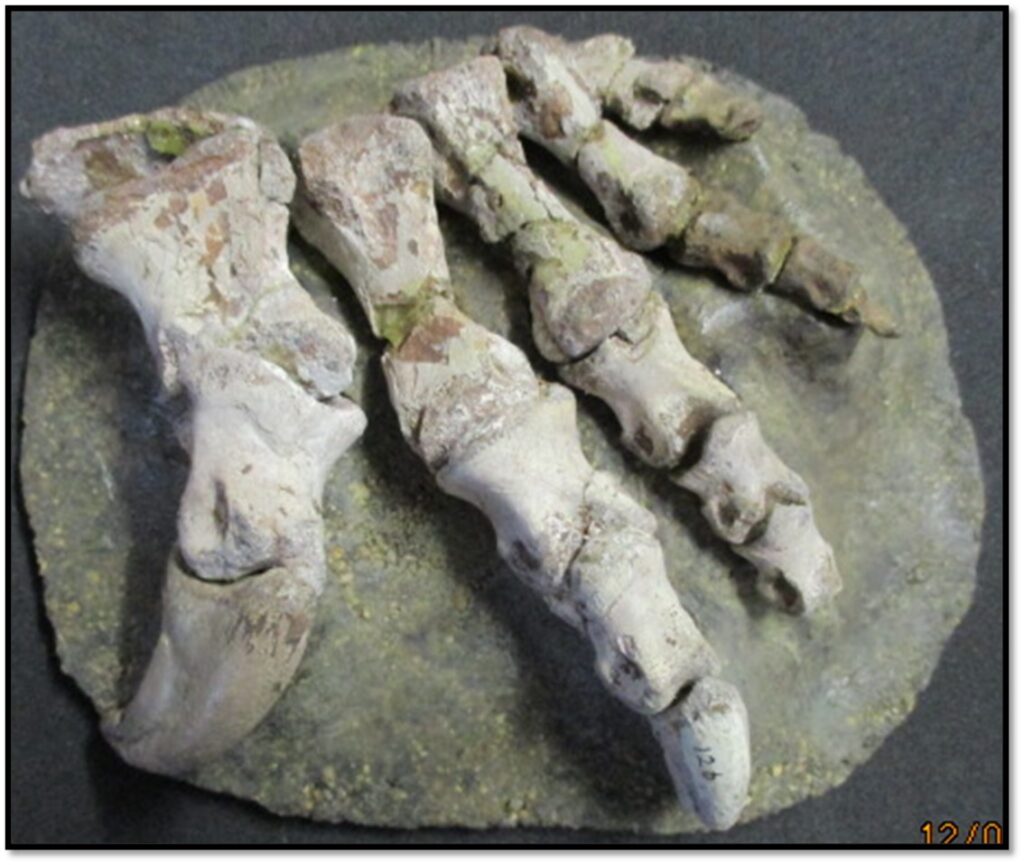
Figure 1: Claw of Massospondylus.
Massospondylus is geologically present in the Massospondylus Assemblage Zone in the upper Elliot Formation, Stormberg Group of the Karoo Supergroup. It is Early Jurassic in age. Clutches of dinosaur eggs are also present in this formation.
References:
CHINSAMY-TURAN, A. (ed.) 2012. Forerunners of Mammals. Indiana University Press, Bloomington and Indianapolis, Pg 330.
MACRAE, C. 1999. Life Etched in Stone: Fossils of South Africa. Geological Society of South Africa, Johannesburg, Pg 305.
NORMAN, D. 1985. The Illustrated Encyclopaedia of Dinosaurs: An original and compelling insight into the life in the dinosaur kingdom. Salamander Books Limited, London, Pg 208.