MILITARY REGIMENTS
By: Michael Tobolo, junior curator, DITSONG: National Museum of Military History
Introduction
When people are organised primarily for the purposes of regulation, control, order, and uniformity, they become regimented. In the medical field, a ‘regimen’ refers to a structured or regulated plan for treatment. This may include a treatment plan, which focuses on how and when to take medication, as well as a lifestyle plan, which outlines rules relating to diet, hygiene and exercise in order to restore or maintain health.
In a military context, a regiment is a structured and foundational organisational unit within an army, primarily established for administrative and recruiting purposes. It is typically a permanent formation consisting of approximately 2,000 to 5,000 soldiers, organised into several battalions and companies.
Regiments provide a strong sense of belonging among soldiers, often fostering a bond in which soldiers come to regard one another as family, even when individual battalions are deployed separately. While regiments often link several battalions together and provide a shared identity, their primary focus is on administration, training, lineage, and history. In this sense, a regiment serves as a “parent” unit to formations of a similar type, such as cavalry or artillery. Modern armies such as those in the United States and United Kingdom, often prefer brigade or brigade combat team structures. A brigade is a tactical organisational unit consisting of multiple battalions, sometimes drawn from different regiments, and is typically commanded by a colonel or a brigadier.
South African Traditional Military Regiments
In South Africa, a number of traditional regiments were established prior to the formation of the unified state. Many of these regiments formed part of the South African Army Reserve Force and have a long history of service under previous governments, although some newer units have also been established. Traditional regiments differ from other military units in several respects. They have distinctive ways of dressing, with notable elements such as the Sam Browne belt and the carrying of swords by officers.
Western Cape
In the Western Cape, there are five traditional Cape Regiments, which form part of the South African Army Reserve Force Regiments in Cape Town. These units were formerly known as the Citizen Force and include:
The Cape Field Artillery/Nelson Mandela Artillery Regiment: This regiment was formed on 26 August 1857 at the old Town House in Greenmarket Square, Cape Town. Its establishment followed a decision by the Governor of the Cape, Sir George Grey, to deploy available military forces to India during the Indian Mutiny. As a result, local military capacity was significantly reduced.
In response, volunteers from the Cape Royal Corps, who had been stationed in Table Bay and engaged in artillery drills, contributed to the formation of what became the Cape Town Volunteer Artillery.
Although the regiment did not serve in the First World War, it participated in the South West Africa Campaign and was mobilised in 1914. It spent three months with General Louis Botha’s forces suppressing the Maritz Rebellion, after which it was deployed to Upington as a garrison unit.
During World War II, the regiment was reorganised in 1940 and merged with the 6th Field Regiment to form the 1/6 Field Regiment (v) of the South African Artillery. It became part of the South African 6th Armoured Division and was deployed to Italy in 1944, where it was involved in the Battle of Monte Cassino. It was also involved in other operations, including the Crusader Campaign, the Halfaya–Sollum Pass engagements, and the Battle of Gazala.
After the war, in 1960, the regiment was renamed Regiment Tygerberg, before reverting to its original name, Cape Field Artillery, in 1963. In the democratic era, it was renamed the Nelson Mandela Artillery Regiment, in honour of South Africa’s first democratic President and Commander-in-Chief of the South African National Defence Force.
Today, the regiment is actively involved in ceremonial duties and regularly undergoes refresher training to maintain operational readiness, including physical fitness, weapons handling (such as the R4 rifle), and computer-based training.
 Nelson Mandela Artillery Regiment: Shoulder Flash |  Cape Fields Artillery Regiment: Shoulder Flash |  Cape Fields Artillery: cap badge. |
Cape Garrison Artillery: Originally established in 1879 as the Cape Town Volunteer Engineers, the unit was later renamed the Garrison Artillery and Engineer Volunteer Corps. A second formation was established in 1942, when South Africa strengthened its home defence capabilities in response to the threat posed by Japan during the Second World War.
 Cape Garrison Artillery Emblem. | 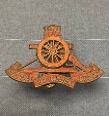 Cape Garrison Artillery: cap badge |
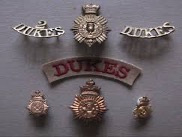
Cape Town Rifles (Dukes): Established in 1855 as a Volunteer Corps, the regiment served in several key campaigns, including the 9th Frontier War (1877 to 1879), operations in the Transkei, the Basotho Gun War (1880 to 1881), the Bechuanaland Campaign (1880), and the Anglo-Boer War (1899 to 1902). It also participated in a number of other campaigns, including the German South West Africa Campaign. In August 2019, the regiment was renamed the Chief Langalibalele Rifles, in honour of the South African Native National Congress.
Cape Town Highlanders: Formed in 1885, the regiment served in several campaigns, including the Anglo-Boer War, the German South West Africa Campaign, the North African Campaign, the Angolan Campaign, and the Border War. It was awarded the King’s Colour in 1904. The Duke of Connaught served as Colonel-in-Chief from 1908 to 1942, followed by Queen Elizabeth the Queen Mother, who held the position from 1948 to 1961. In 1967, the regiment was granted the Freedom of the City of Cape Town.
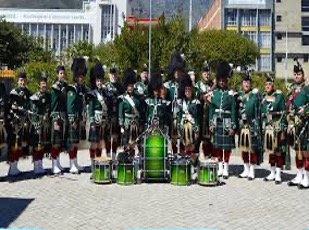 The Cape Town Highlanders Pipe Band. | 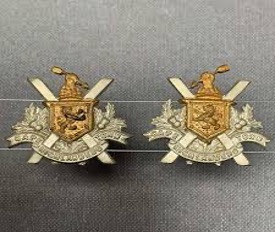 Cape Town Highlanders: Set of collar badges. |
Regiment ‘Westelike Provinsie’ / General Jan Smuts Regiment: Currently known as the General Jan Smuts Regiment, it was formed in Stellenbosch as a Citizen Force Unit in 1934. The regiment served with the South African Tank Corps during the North Africa Campaign from 1941 to 1942. It relocated to Paarl in 1948 and was converted to an armour unit. Later divided into two battalions, the regiment participated in the Angola Campaign and the Border War. It has also been awarded the Freedom of the City of Cape Town.

KwaZulu-Natal
KwaZulu- Natal is home to a number of traditional regiments, including:
Natal Carbineers: Currently known as Ingobamakhosi Carbineers, the regiment traces its origins to a 19th-century Zulu regiment, Ingobamakhosi, which was famous for its role in the Battle of Isandlwana. The unit was initially established in 1854, formally introduced in January 1855, and gazetted in March 1855 as the Natal Carbineers. In 1913, the regiment was divided into two wings, known as the First and Second Mounted Rifles. By 1934, it reverted to the designations of First and Second Natal Carbineers and later became the Royal Natal Carbineers.
Since 1994, the regiment has been actively involved in supporting the South African Police Service with internal duties, assisting in border protection, and contributing to peacekeeping missions in the Democratic Republic of the Congo (DRC).
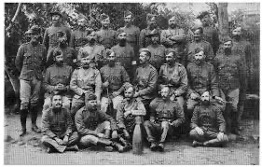 Many officers of the Natal Carbineers saw active service during the Anglo-Boer War. | 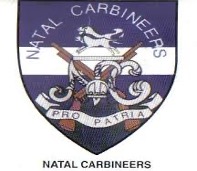 The badge of the Natal Carbineers. |
Natal Mounted Rifles / Queen Nandi Mounted Rifles: The regiment traces its origins toa public meeting held at a hotel on 23 March 1854.
It was formally established in May 1968 through the amalgamation of four volunteer units by the Regimental Committee: The Royal Durban Rangers, Victoria Mounted Rifles, Alexander Mounted Rifles, and Durban Mounted Rifles, giving rise to the Natal Mounted Rifles.
Umvoti Mounted Rifles: Named after the Umvoti River, the regiment was originally founded in Greytown as the Greytown Mounted Rifles on 16 May 1864, consisting of only forty-five men under the command of Captain A. S. Wyndham, who was the magistrate of Greytown at the time.
The Masonic Hall, the oldest hall in Greytown, served as the regiment’s headquarters. It was later renamed the Umvoti Mounted Rifles, and the hall, now known as the Umvoti Mounted Rifles Hall, is currently used by the Greytown Public Works Department.
The modern formation of the Umvoti Mounted Rifles occurred in 1893, following the redesignation of the left wing of the Natal Carbineers. The regiment also absorbed the Zululand Mounted Rifles and was redesignated as the 4th Mounted Rifles (Umvoti Mounted Rifles). It was transferred to the active Citizen Force of the Union Defence Force and converted to infantry. The regiment subsequently served in the second Anglo-Boer War, The Zulu Rebellion, World War I (specifically in South West Africa between 1914 and 1915), World War II and the Border War.

Other notable Kwa-Zulu Natal regiments include the Durban Regiment (also known as the King Shaka Regiment), the Natal Field Artillery, and several units that follow the traditional regimental structure.
Gauteng: In Gauteng, notable regiments include the Bambatha Rifles (formerly known as the Witwatersrand Rifles), the Transvaal Scottish Regiment, the South African Irish Regiment, and the Light Horse Regiment.
Bambatha/ Witwatersrand Rifle: Named after Nkosi Bambatha kaMancinza Zondi (1865–1906), the leader of the Zondi clan, who led an armed rebellion in 1906 against British colonial rule in Natal after refusing to pay the harsh poll tax imposed by the colonial government between 1905 and 1906. Although the circumstances of his death remain controversial, it is believed that he was shot and stabbed while attempting to escape along the Mome Stream. The name Bambatha Rifles was adopted by the South African National Defence Force (SANDF) as part of the country`s efforts to align military unit names with the democratic dispensation. The regiment’s origins trace back to 1 May 1903, shortly after the second Anglo-Boer War, when the Railway Pioneer Regiment and the Rand Rifles were merged to form the Witwatersrand Rifles (now Bambatha Rifles).
The regiment served in World War I in South West Africa between 1914 and 1915, later expanded to two battalions, and subsequently served in Italy as part of the Armoured Division alongside De la Rey. It also took part in the South West Africa / Angola Border Wars. In modern times, the regiment has contributed to peacekeeping missions in the Democratic Republic of the Congo (DRC) and provided volunteers for border security during the COVID-19 pandemic.


Other notable Gauteng regiments include the Transvaal Scottish Regiment, also known as Solomon Mahlangu Regiment, the South African Irish Regiment, changed to Andrew Mlangeni Regiment, and the Johannesburg Light Horse Regiment, formerly the Light Horse Regiment.
Indigenous Traditional Regiments
Indigenous traditional regiments were established for several purposes, the most prominent being the Amabutho system during the era of King Shaka Zulu, with origins dating back to pre-Shaka Zulu times. These regiments were highly organised and structured as disciplined warrior units, forming the backbone of the military and social structure of the Zulu Kingdom. Youth were recruited based on age groups and often housed in royal barracks known as Amakhanda, meaning “heads”. Both young men and women were brought together for cultural ceremonies, including traditional weddings, and to serve as ceremonial guards for the Zulu nation.
Zulu military regiments participated in numerous battles, the most notable being the Battle of Isandlwana under the leadership of King Cetshwayo kaMpande, which resulted in a major victory for the Zulu Kingdom on 22 January 1879.

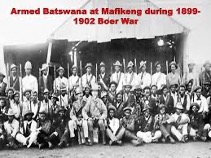
The Batswana regiments, known as Mophato, consist of young men and women who attend initiation schools every four years according to their age-set groupings. These schools instil discipline, respect for authority, and social cohesion. Upon completing initiation and graduating to adulthood, members serve as maletamotse (“village commandos”), performing duties such as building infrastructure, farming, hunting, and participating in cultural ceremonies.
Some Mophato regiments also functioned as the military arm of their society, defending their territory against external threats such as the Ndebele. They participated in major conflicts, including the Siege of Dimawe, and in 1900, three Tswana regiments of the Bakgatla clan fought alongside the British against a Boer laager.
Other indigenous traditional regiments include the Venda regiments, which were also organised according to age-group systems known as Milalo. During the 19th-century Venda-Boer War in the Soutpansberg, King Mphephu was supported by the Ngomakhosi of Sinthumule as well as his own
Mavhengwa Regiment, which consisted of several battalions, including:
- Mavhoi – Responsible for the security of the king.
- Maunavhathu – Renowned as fearless warriors tasked with protection against external threats.
- Vhaingamela – Known for their role in obstructing Boer attempts to conquer Venda.
- Manenu – A strong northern battalion tasked with defending the kingdom against external invasions.
Regiments from other tribal groups also played a key role in defending and fighting for their people, including the Xhosa, Pedi, Basotho, and Tsonga, during the pre-colonial era.
Conclusion
Regiments differ significantly from country to country in their function, structure, and heritage, shaped by the tension between maintaining historical tradition and adapting to modern, flexible combat needs.
Most South African traditional regiments changed their names as part of the country`s efforts to align military names with the new democratic dispensation.
Regiments have adapted their roles due to downsizing and mergers, reflecting the realities of a world shaped by advancing technology, where military dominance increasingly depends on technological superiority. Regiments support police services in combating crime, assist in disaster relief, participate in peacekeeping missions, contribute to border protection, and perform ceremonial duties, as well as support skills development programmes for the youth.
References
1. McKenzie, Angus G (1957). The Dukes – A History of the Duke of Edinburgh’s Own Rifles. Cape Town: Published for the Regimental Council of the Duke of Edinburgh’s Own Rifles by Galvin & Sales. OCLC 19862498. Retrieved 19 December 2014.
2. Orpen, Neil D. (1984). Cape Town Rifles: Dukes. Cape Town: Cape Town Rifles Dukes Regimental Council. ISBN 9780620083409. OCLC 16870041. Retrieved 19 December 2014.
3. Journal of Southern African Studies 38(2):385-397 DOI:10.1080/03057070.2012.683600, June 2012.