ORIGINS OF THE EASTER BUNNY: A Tale of Myth and Tradition
By: Frank Teichert, Curator, DITSONG: National Museum of Cultural History

The Easter Bunny, that fluffy, whimsical creature delivering colourful eggs and joy to households worldwide, has a surprisingly rich and complex history. Far from being simply a modern mascot for Easter, the origins of the Easter Bunny weave together ancient pagan customs, Christian traditions, and a sprinkling of folklore from across continents.
The Pagan Roots of the Easter Bunny
The rabbit, with its reputation for prolific breeding, has long been a symbol of fertility and renewal. These qualities connected it to ancient spring festivals, particularly those celebrating the goddess Ēostre (or Ostara). Ēostre was a pagan deity associated with dawn, spring, and fertility in Germanic traditions, and her festival marked the time of year when days grew longer and nature came alive after winter’s slumber. Ēostre is believed to be a goddess who represents dawn and the returning warmth and light after winter. Her festival was celebrated around the time of the spring equinox, marking a balance between day and night and the renewal of life in nature. The name Ēostre is connected to the word “Easter” in English, as well as to the month “Ēosturmōnaþ” (Eosturmonth) in Old English, which corresponded to April. The Venerable Bede, an 8th-century monk and historian, mentioned Ēostre in his writings, noting that her festival was replaced by the Christian celebration of Jesus’ resurrection. Some traditions connected to Ēostre involve symbols of fertility and rebirth, such as hares or eggs. Although historical evidence of her worship is sparse, she has become a prominent figure in modern interpretations of paganism, such as Wicca and neopaganism, where her legacy is celebrated as part of spring rituals.
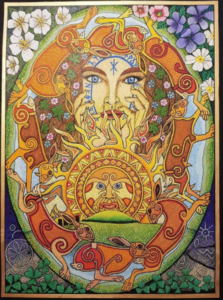
Artists’ Impressions of Ēostre

Ēostre is an interesting and enigmatic figure, blending history, myth, and cultural symbolism. According to some accounts, the hare was sacred to Ēostre, symbolizing new life and vitality, themes central to springtime celebrations.

Ēostre the Symbol for Fertility and Rebirth.
The Easter Bunny and Christianity
As Christianity spread across Europe, it absorbed elements of pagan festivals to facilitate the transition for converts. The festival of Ēostre gradually blended with Christian observances of the resurrection of Jesus, and symbols of renewal like the rabbit persisted, taking on new meaning within the Easter context.
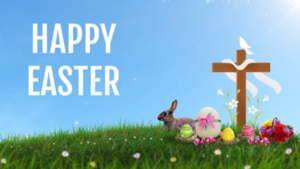
Christian symbol of the resurrection of Jesus.
The association between rabbits and Easter began to solidify in the 17th century, particularly in Germany. Folklore tells of the “Osterhase,” an egg-laying hare that delivered brightly coloured eggs to well-behaved children. This tradition of the “Osterhase” may have stemmed from pre-Christian customs that involved fertility rites and spring renewal rituals. According to the tradition, the “Osterhase” was a hare that laid colourful eggs for well-behaved children during the Easter season. Families would prepare nests, often made of hats, baskets, or other materials, where the Osterhase could leave its eggs. These eggs, symbolizing fertility and new life, were often dyed or painted in bright colours, much like the decorated eggs we associate with Easter today.

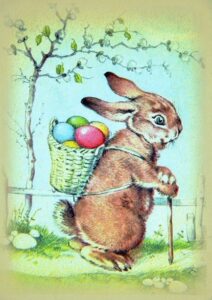
The “Osterhase” is a fascinating example of how folklore can travel, adapt, and evolve across cultures
The Easter Bunny Crosses the Atlantic
German immigrants brought the “Osterhase” tradition to America in the 1700s. They settled in Pennsylvania and carried with them the charming custom of creating nests where the mythical hare could lay its eggs. Over time, the Easter Bunny and its egg-laying antics captured the imaginations of Americans from all cultural backgrounds. Over time, the tradition evolved and became more widely embraced, eventually transforming into the Easter Bunny we know today. While the hare was initially tied to themes of spring and fertility, its role as a bringer of treats expanded to include other elements, such as chocolate eggs, candy, and toys hidden for children to discover, which in turn is largely a result of modern commercialization.


By the 20th century, the Easter Bunny became a staple of the Easter celebration, particularly in Western culture.
A Modern Symbol of Joy
Today, the Easter Bunny is as much a commercial icon as it is a symbol of springtime joy and childhood wonder. It represents the blending of ancient traditions with contemporary customs, creating a character beloved by children and adults alike.


Though its origins may be rooted in fertility rites and folklore, the Easter Bunny continues to bring smiles and sweetness to families worldwide, proving that sometimes the simplest symbols hold the richest histories.
Happy Easter to all our readers.