THE ADZE: SHAPING WOOD AND CULTIVATING SOIL
By: Judas Makwela, Junior Curator, DITSONG: National Museum of Cultural History
Introduction
An adze (/ædz/ or adz) is an ancient and versatile cutting tool, similar to an axe, but with the cutting edge set perpendicular to the handle rather than parallel. Adzes have been used since the Stone Age and served a variety of purposes, from smoothing or carving wood in hand woodworking to use in agriculture and horticulture.
This article focuses specifically on the agricultural adze, which functions as a hoe. A hoe is a gardening tool with a long handle and a blade, used for cultivating soil, removing weeds, and preparing land for planting by shaping the soil and creating furrows or trenches.

Figure 1. Traditional adze with a T-shaped shaft and cutting edge, used for shaping wood. (Collection, DITSONG: National Museum of Cultural History).
The Adze: Form, Development and Use
The adze is a hand tool used primarily for shaping wood. As one of the earliest tools, it was widely used in Stone Age cultures in the form of a handheld stone, carefully chipped to create a cutting edge. By the time of ancient Egypt, the adze had evolved to include a wooden shaft, or handle, with a copper or bronze blade mounted flat at the top, forming a T-shape. In this configuration, the adze remained the principal hand tool for shaping and trimming wood.
Carpenters would place a log or piece of timber on the ground or floor and stand astride it, swinging the adze to remove material. Adzes were used to remove heavy waste, level surfaces, and shape or trim timber and boards, making them essential for woodworking across centuries.
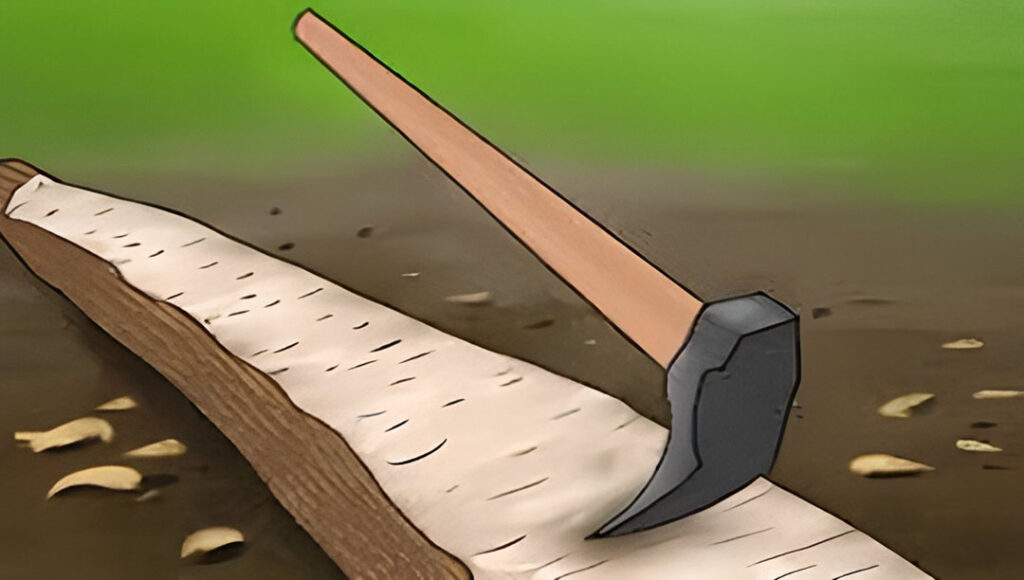
Figure 2. This illustration demonstrates the use of an adze in woodworking. Generally, the user stands astride a board or log and swings the adze downward between their feet, chipping away pieces of wood while moving backward, leaving a relatively smooth surface behind (Source: https://www.wonkeedonkeetools.co.uk/adzes/selecting-an-adze-other-information).

Figure 3. Traditional adze with a metal blade, illustrating the perpendicular cutting edge characteristic of this versatile woodworking tool (Collection: DITSONG: National Museum of Cultural History).
Conclusion
This article examined the introduction of the adze in the thirteenth century. Initially used by Europeans for woodworking, the tool was later acquired and adapted by African communities to suit local needs. In South Africa, the adze remained in use for many decades after its introduction, taking considerable time to be phased out and replaced by mechanised tools. Even today, in some rural areas, adzes continue to be used as practical alternatives where machinery or electrical power is unavailable for production purposes.
References
DITSONG: National Museum of Cultural History, Metal Collection, (Accession Number: L 1124: figures 1 and 3).
Sloane, Eric. 1964. A Museum of Early American Tools. USA: Dover.
Photographs (Figures 1 and 3), Judas Makwela (Junior Curator), DITSONG: National Museum of Cultural History.