THE COELACANTH
By: Heidi Fourie: Curator, DITSONG: National Museum of Natural History
The coelacanth with Latin name Latimeria chalumnae was discovered by Marjorie Courtenay-Latimer on 22 December 1938 while she worked as a curator at the East London Museum. The coelacanth first appeared in the Devonian period on all continents but Antarctica. At least two species occurred in South Africa, one from KwaZulu-Natal Province and the other from the Free State Province. It is currently still under threat, and it is present on the CITES (the Convention on International Trade in Endangered Species of Wild Fauna and Flora) list of endangered species.
This fish can grow up to 1.4 metres in length and weigh as much as 95 kg. It has a steely blue body flecked with white blotches, and its pectoral, pelvic, second dorsal, and anal fins are borne on limb-like lobes. The tail is in three parts, and its skeleton is primarily cartilaginous. They give birth to live young, with up to 67 eggs developing internally before hatching. Cool water between 15ᵒ – 20ᵒ C is required for its survival, typically at depths of between 150 to 200 metres, however, depths of 700 m are sometimes reached. They are nocturnal hunters and frequent caves where they hunt mostly eel, beryx, snapper, beard fish, cardinal fish, and swell sharks.
A fish believed to have been extinct for 65 million years became extant and is classified in the Crossopterygii in the Order Coelacanthiformes. This living fossil now provides an opportunity for scientists to fill in the blanks left by the fossil record. A second coelacanth was only caught in 1952, followed by several more specimens, which were later studied in Paris. This fish seems to frequent the waters around the Comoro Islands, East London (South Africa) and Madagascar.
The DITSONG: National Museum of Natural History has in its collection several coelacanth fossils. One is on display. Fossils in South Africa are from the Grahamstown shale and Beaufort Group.
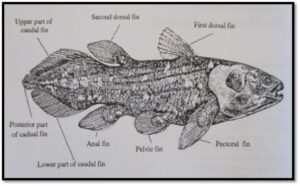
Figure 1: Stylized drawing of a coelacanth (Greenwood 1993).
Source: Greenwood, P.H. 1993. Latimeria chalumnae – The Living Coelacanth. @ICHTHOS, J.L.B. Smith Institute of Ichthyology 1993, NMB Printers, Port Elizabeth.