BOLT’S FARM PALAEOKARST SYSTEM SCORE CARD (1995-2025)
By: Lazarus Kgasi, Junior Curator, DITSONG: National Museum of Natural History
The Plio-Pleistocene epoch (5.3–1.8 million years ago) marked a pivotal era in the evolution of primates, including human ancestors and other mammals. This period is especially significant in South Africa’s Cradle of Humankind World Heritage Site, where sites like Bolt’s Farm (figure 1) preserve a remarkable fossil record. The following is a synthesis of key evolutionary and migratory patterns observed for three decades of excavation.
Bolt’s Farm is a karstic cave system with over 30 fossil deposits spanning 4.5 to 0.9 million years, offering the longest continuous chronological sequence in the region.
Key findings include:
Primates – The site has yielded some of the oldest cercopithecoid (Old World monkey) fossils in South Africa, including Parapapio broomi (figure 2) and Parapapio whitei (extinct medium-sized baboons), as well as Theropithecus (gelada relatives) and Cercopithecoides williamsi (colobines). These primates suggest ecological diversity, with some species adapted to open grasslands and others the presence of trees. Carnivores – The “false” sabre-toothed cat Dinofelis barlowi, Panthera shawi and other large felids dominate the carnivore record, indicating a predator-rich environment. Other Fauna – Antelope (Antidorcas recki), giant horses, and rodents like Euryotomys bolti reflect shifting habitats from woodlands to grasslands.
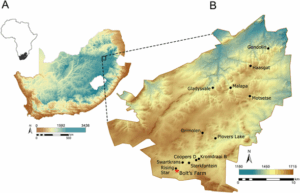
Figure 1. (Image by Ewards et al.).
Recent research has challenged the earlier age estimates of Bolt’s Farm, suggesting that its deposits are younger (2.27–1.7 Ma) than previously thought. This aligned with major climatic shifts during the Plio-Pleistocene transition.
Although Bolt’s Farm has not yet yielded hominins, nearby sites such as Sterkfontein preserve Australopithecus africanus (3.3–2.1 Ma), a bipedal hominin with both arboreal and terrestrial adaptations. The Haasgat site (northern Cradle) has produced a hominin molar (~1.95 Ma) possibly linked to late Australopithecus or early Homo, highlighting regional diversity during this transitional period. The gelada relative Theropithecus oswaldi was widespread across Africa and even reached Eurasia during the Plio-Pleistocene, probably as a result of its ability to thrive in open habitats. Its eventual decline, in contrast to the success of Homo, may have resulted from interspecies competition or climatic changes.
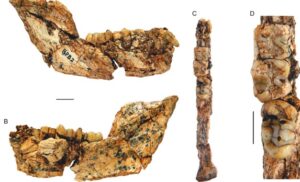
Figure 2. Right mandible of Parapapio broomi from Bolt’s Farm, specimen BPB 2: A, buccal view; B, lingual view; C, superior view; D, occlusal view of m/1-m/3 Scale bar: 10 mm.
Except for the oldest site of Bolt’s Farm (Waypoint 160) where the environment was probably drier than today, fossil evidence suggests that the site transitioned from a more wooded (tree-covered), humid environment (probably with some seasonal variation) to increasingly open and drier environments by ~2 Ma. This environmental shift is reflected in primate and bovid communities. Grazers like Equus appeared alongside browsers, indicating mosaic landscapes.
Around 2.5 Ma, South Africa experienced a major turnover in large mammals, coinciding with global cooling and the expansion of C4 grasslands. These environmental changes may have driven the decline of tree-dependent monkeys (food and refuge) and the emergence of Homo and Paranthropus.
Fossil accumulations at Bolt’s Farm—often the result of carnivore activity or accidental falls into natural ‘death traps’ such as Pit 23—both complicate and enhance palaeoecological interpretations.
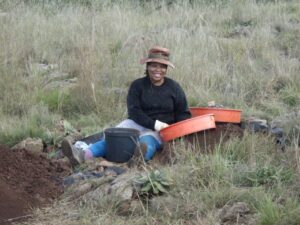
Figure 3. Dr Nonhlanhla Vilakazi sieving sediment at the Brad Pit fossil site, Bolt’s Farm, during fieldwork in 2025.
South Africa’s non-human primate and faunal records show parallels with those of East Africa (e.g., Theropithecus dispersal), while also displaying unique regional traits, such as the dominance of Papio angusticeps at Haasgat. These patterns highlight the importance of the Cradle of Humankind as a distinct and significant evolutionary hotspot.
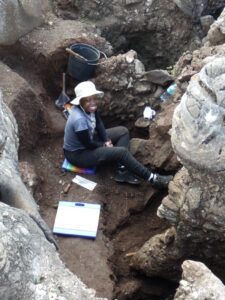
Figure 4. Ms Boitshepo Motsodisa at work during the 2025 excavation at Bolt’s Farm (Brad Pit Fossil site).
In conclusion, Bolt’s Farm and the broader Cradle of Humankind reveal a dynamic Plio-Pleistocene world where primates, including hominins, and other mammals adapted to climatic volatility. The site’s fossils—from baboons to sabre-tooths—are “Vidal clues” that illuminate not just human origins but the broader tapestry of life’s resilience and transformation. Ongoing excavations supported by international collaborations such as the France-South Africa partnership, continue to refine this narrative, bridging pixelated gaps in our evolutionary story.