Gustav Schoeman Preller And The Kruger Millions: Fabricated Or Fact
By: Jan van den Bos, Curator: DITSONG: National Museum of Cultural History
As a writer, historian and journalist, Gustav Preller (1875-1943) dedicated his career to the history of South Africa. His publication: Day-Dawn portrays the history of South Africa between 1836 and 1909. He studied the indigenous people of South Africa and published the historical events surrounding the reign of the Transvaal born king, Lobengula Khumalo in: Lobengula: The tragedy of a Matabele king.
Preller became the editor of the newspapers Land en Volk (1902), De Volksstem (1903) and Ons Vaderland (1925). As the co-editor of Die Brandwag magazine (1910 to 1922), he shared countless stories. The mystery around the “disappearance” of the Kruger millions during the Anglo-Boer War (1899-1902) is one such an example.
On 28 May 1900, the Head of Mining in the South African republic, Mr. J.B.(Kootjie) Kleynhans, called Preller from the battlefield for a brief period to assist with the administration of the state gold. Preller, who used to work as a clerk in the Department of Mining since 1893, adhered to the call and returned to the Transvaal.
The assignment
Preller was assigned to receive all gold bullions from the Mining Engineer, Mr. J.H. (Hendrik) Munnik, at the State Mint, located behind the National Bank and Mint on the northwestern corner of Church Square, Pretoria. After weighing the gold, Preller issued a receipt to the Head of the Mint, Mr. A. Perrin. German Swiss artisans, the Meyer brothers, (Alfred, Eric and Theophil) molded the bullions by melting, sheering, mixing and rolling it into the precise coin weight and size. A currency was added by using a manual operated lathe. Thereafter the coins were assigned to Treasurer-General N.S. Malherbe and Auditor-General Jan Marais (nicknamed Jannie Sambaal) for distribution.
The minting process continued until the end of May 1900, before British troops entered Pretoria on 5 June 1900. The staff, however, could not compete with the minting demand and some clients were reimbursed in gold.
As clerk, Preller gained insight into the production of gold coins. He had studied the weight, quality and value of bullions from an early age. While Preller assisted in the receiving and transferring processes of gold bullions during the war, he also played a significant role in the “disappearance” of the state gold.
State Attorney J.C. Smuts commissioned the Head of the Mint, A. Perrin, to remove the gold bullions from the square before British troops entered Pretoria. The latter settled on the time and date being the evening of 28 May 1900, only two days before a decision was taken to surrender the capital. Chaos erupted on the night of 31 May 1900 when villains plundered Pretoria and forced their way into the government storage facility in Mark Street. (today the premises of DITSONG: National Museum of Natural History).
Gold repositories were allocated to different buildings on the square. These locations included the Netherlands Bank building on the west side, the Mint building behind the National Bank and the Palace of Justice, both on the north side.
Arrangements
When Perrin requested Preller to arrange transport, the Head of the Mint withheld the true reason behind the assignment for security reasons. Perrin convinced Preller that the required transport was for the delivery of commando provision. On the evening of 28 May 1900, Smuts personally informed Preller of the real reason behind the assignment.
While Preller embarked on a wagon mission, Mr. J.S. Marais, the Auditor-General, his Clerk, Mr. N. Noomie, and the Manager of the Netherlands Bank, Mr. De Braal anxiously waited for the arrival of Preller at the Square. Meanwhile Treasurer-General Malherbe waited at President Kruger’s coach at the station to receive the gold, complete the paperwork and place the gold in the safes before Kruger and his staff departed for Machadodorp.
At dawn and after a prolonged search, Preller came upon an open, (trolley) wagon in Sunnyside. The owner (Joe), who opposed government rules, refused to hand over his possessions and demanded a discussion with the authorities. Preller referred the owner to Smuts while taking possession of the wagon, the driver and the two mules.
Smuts was patiently waiting at the Square for the arrival of a wagon. Much to his relief, a wagon arrived and at 11 pm the first load from the Netherlands Bank left for the station. Smuts then informed Preller of the new transport arrangement. Since the owner of the wagon demanded payment, Smuts considered it best to hand the wagon back and replace it with a cab, two horses and a new driver.
A second load from the Mint building included bullions, blank coins, used gold plates, gold waste particles, punching machines and stamps. The final and heaviest load comprised of large bullions stored in the ground floor vaults of the Palace of Justice.
Munnik arranged for the removal of the last raw gold from the Johannesburg mines. Police escorted the freight to the Treasury on wheels (the temporary seat of government) at Machadodorp. Following an agreement between the Zuid-Afrikaansche Republic (ZAR) and Germany, Marais transferred an even weight of raw gold to a German company in Hamburg to refine of the gold and the mint of coins. The freight left the port of Lourenço Marques (today Maputo), under the watchful eye of the South African Consul-General (Plenipotentiary) for The Hague. The freight arrived safely in Germany. The Mining Commissioner, Mr. J.L. van der Merwe, received £25 000 of the processed coins at the port of German Southwest Africa (today Namibia) on behalf of the ZAR.
Estimated number of gold bullions
Preller estimated the number of high-quality bullions which were removed from the square premises at one hundred. These bullions weighed between seven and 50 pounds (3 and 22 kilograms) and calculated to a value of about £1,5 00,000. A small percentage of low grade cyanite and mill gold valued between £2.10.0 and £3.17.6 per ounce (28 gram) was included in the total estimated value amount.
Payouts and distribution
The Mint could no longer compete in demand, and suppliers were reimbursed in gold ounces instead of coin payouts. After a quality and value test, the Mining Engineer issued an owner certificate to the receiver of the gold. Expenditures mainly included commando essentials such as food and clothing which were supplied by a German company. An unspecific but small number of payments were also issued by the Treasury (on wheels) for the commandos.
Individuals such as the magnate Sammy Marks received a gold reimbursement of £2 000 for the delivery of coal to the mines and an amount of £100 was paid to general dealer Frenkel for providing saddles. Preller questioned whether the two could ever have settled these legitimate payments without a certificate in the absence of the Mining Engineer.
After the Battle of Dalmanutha at the end of August 1900, members of the Exclusive Council met at Waterval Boven to discuss the future position of the two republics at war. With all parties present, the Council divided the remaining gold, and coins between the Orange Free State and the Transvaal (ZAR). Preller estimated the total amount, before the division, to be £20 000.
Endorsement
Gustav Preller published the story of the Kruger millions in various magazines (see Sources below). His publication, Ons Parool (Our Parole) deals with his imprisonment in India during the Anglo-Boer War. Preller, however, devoted an entire chapter in this publication to the Kruger millions. The scenario is identical to the stories he published in Die Brandwag and Die Huisgenoot magazines.
(Source: Kr 3043, Document collection, DNMCH)
Eric Meyer, artisan and one of the brothers who worked at the Mint, saw Preller’s article in The Star newspaper. Meyer found discrepancies and untrusted statements in Preller’s Kruger Million story. The South African born brothers, (not German Swiss brothers as indicated by Preller) Eric and Alfred Meyer, who lived near Preller, occasionally called on each other. Eric stated that they talked about the removal of the gold from the Mint on one occasion. Preller, however, was never present when officials removed the gold in broad daylight from the Mint and delivered it to the station on 4 June 1900.
Smuts commissioned Perrin at 9 am that morning to remove the gold, while he (Smuts) arranged for a coach and two trolley wagons to load the gold from the National Bank at the Square. Perrin and the Manager of the National Bank, Mr. Hugo, gave orders to have all the gold brought together, weighed, listed, signed and packed under the supervision of the Mining Commissioner. At 2 am the two trolley wagons under armed guard arrived at the station.
According to E. Meyer the gold differed in quality and consisted of strips and bullions. Roughly £ 100 000 were stamped with the1900 die. The total value of the gold amounted to £ 750 000.
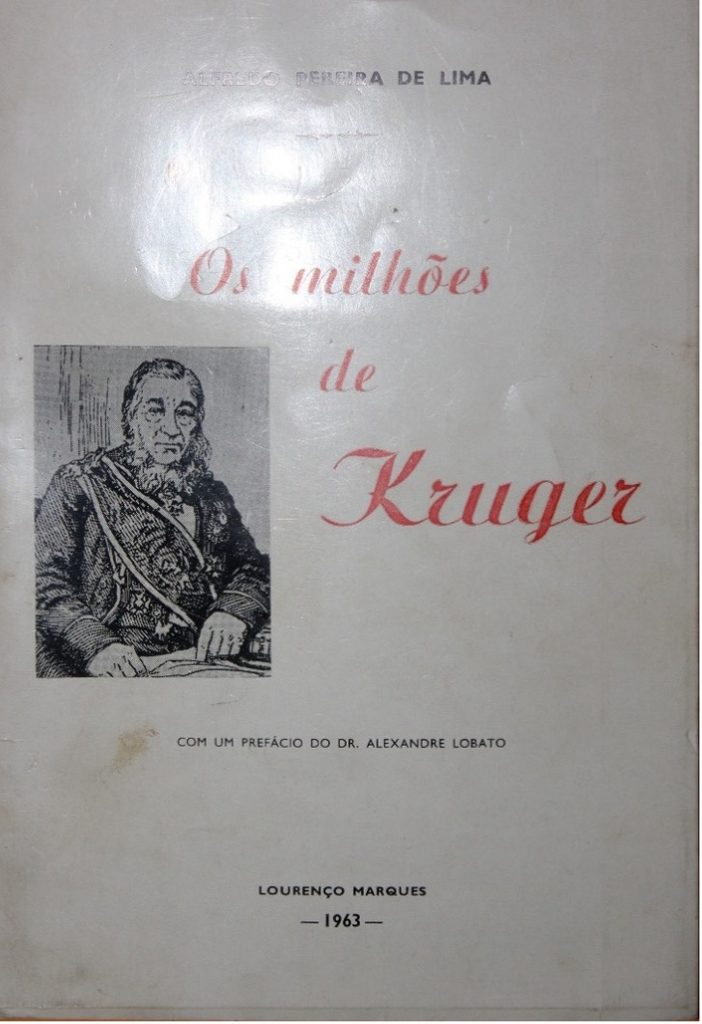
This Portuguese publication claimed Kruger millions worth more than two million pounds
(Source: Kr 1500, Document collection, DNMCH)
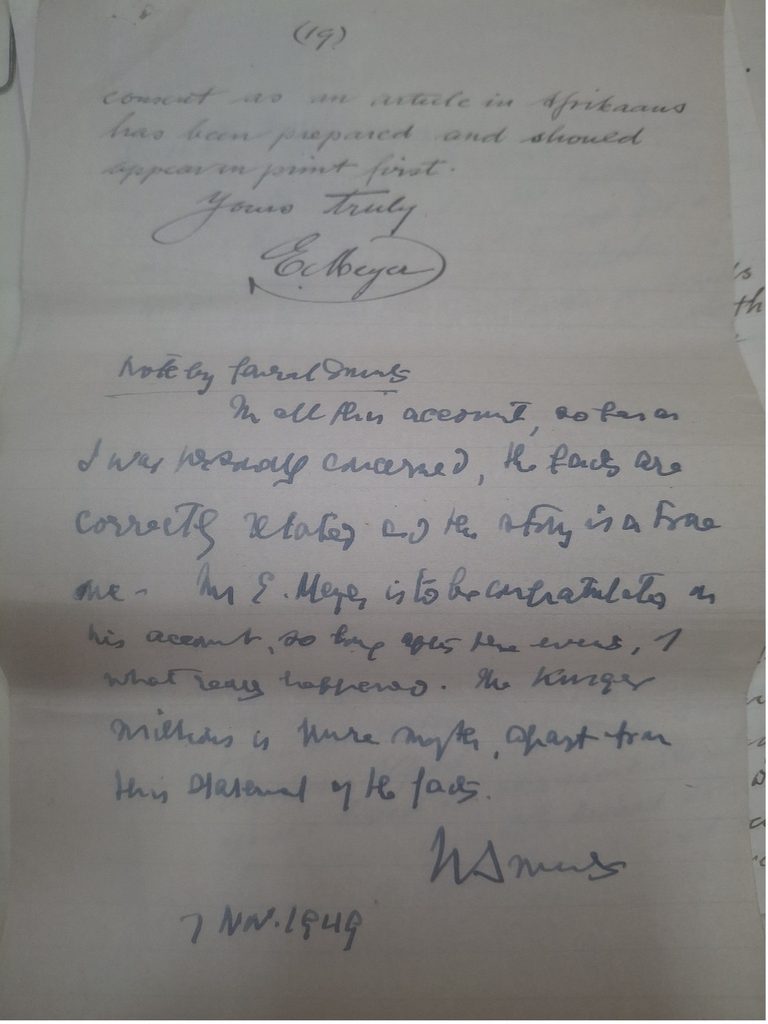
(Source: National Archives of South Africa, TAB, A 501)
Wording of Smuts’ note
In all this account, so far as I was personally concerned, the facts are correctly related, and the story is a true one. Mr. E. Meyer is to be congratulated on his account, so long after the events, of what really happened. The Kruger Millions is pure myth apart from this statement of the facts. J.C. Smuts, 7 November 1949.
Conclusion
While with the Department of Mining, Preller’s clerical duties involved administrative and file record tasks. The removal of the state gold implied governance on a higher level, the involvement of selected staff, precise practices, the correct documentation procedures and the presence of a security guard. Preller’s personal involvement in the removal of the gold is untrue and is based on the story of a staff member who worked in the Mint at the time. The credibility of the writer is being questioned, facts are inaccurate and unreliable. On the contrary, the story focuses on entertainment instead of facts.
The story of the Kruger millions will remain controversial, regardless of fabricated or fact.
Sources
Preller, G.S., Ons parool. Dae uit die dagboek van `n krygsgevangene.Nasionale Pers, Kaapstad, 1943.
Preller, G.S., Waarheid of kwaadwillige fabel, jn Brandwag (XIII), 5, 1921.10.25.
Preller, G.S., Wat waar is van die “Kruger-miljoene”en wat nie, in Die Huisgenoot, (X), 187, 1925.10.09.