UNLOCKING THE PAST: IDENTIFICATION AND FINDINGS FROM AN HISTORICAL OBJECT INQUIRY
By: Tinyeko Captain Ndhlovu, Curator, DITSONG: National Museum of Military History
Museums serve as an important bridge between the public and history. When handling inquiries about heritage objects, a museum fulfils several key roles such as being the custodian of public knowledge, engaging and building trust with the community as well as add new information to a museum record. Through education and public engagement museums can bridge the gaps between diverse cultures and time periods by acting as centres for historical interpretation and community dialogue. Museums provide accessible, evidence-based and historical context. They also help the public understand the origins, cultural significance, and historical narratives of an object, which promotes public learning and knowledge sharing. By answering public queries, museums foster community relationships and cultural dialogue. This open engagement respects diverse knowledge systems and occasionally leads to new historical discoveries, oral histories, or the responsible acquisition of new items for the museum’s own collection (Atkinson, 2026; Amsel, 2025; Macala, 2025; Mutoni, 2025; Rajan, 2024).
Historical artifact inquiry
In early 2026, a member of the public contacted the DITSONG: National Museum of Military History (DNMMH). She sought historical clarification on an object she inherited from a deceased 91-year-old friend. Driven by a passion for historical preservation and a desire to uncover the origin of her personal collection, she sought expert identification for the piece, which was initially thought to be a badge.
Tinyeko Captain Ndhlovu, DNMMH Curator of Insignia: Badges, Hobs and Dies, Plaques and Crests Collection, researched the object and provided the findings to the owner. The object was classified as a Commemorative Medal for the 1961 Formation of the Republic of South Africa. Museums often utilise standardised documentation benchmarks like the global Object ID Standard to record descriptions, maker details, and markings to verify what an object is (ICOM, n.d.).
The identification was restricted to the historical context and physical description of the medal. In accordance with professional standards and ethical frameworks such as the International Council of Museums (ICOM) Code of Ethics – which restricts members from endorsing specific commercial dealers or providing public valuations – museum experts help identify objects’ materials, age, and cultural styles (Atkinson, 2026). DNMMH curators, in line with international museum best practice, do not provide market valuations or financial appraisals for heritage assets.
Historical context
The medal marks a pivotal moment in South African history. In March 1961, South Africa withdrew from the British Commonwealth due to international pressure regarding its apartheid policies. On 30 May 1961, Governor-General Charles Robberts Swart resigned from his position, effectively ending Queen Elizabeth II’s role as Head of State. The following day, South Africa officially declared itself a republic, and Swart was inaugurated as its first State President (Numista Numismatic Database, 2026; Randcoin Numismatic Archive, 2026; South African History Online, 2011).
To mark the occasion, the government produced distinct versions stamped by the South African Mint (S.A.M.). Commemorative sets featuring gold, silver, and bronze medals (manufactured without lugs) were officially issued in oblong, blue “S.A.M” presentation cases. The cases were lined with white silk and blue velvet. Single silver medals were available in a similar square case. Conversely, a bronze/bronzed school issue version featuring a suspension lug was distributed to all school children across the country. This version is the most common variety of the medal found today (Randcoin Numismatic Archive, 2026).
These medallions were struck in three metals:
Gold: Featured in limited prestige sets.
Silver: Issued both in sets and individually in square presentation cases.
Bronze: The most prevalent variety, distributed to all South African school children (1961) and which included a small lug (loop) for suspension.
Key features and specifications of the medal. Features and specifications listed refer to the school-issue bronze version, with diameter measurement, including the lug, as per standard cataloguing guidelines.
| Location | South Africa |
| Type | Commemorative medals |
| Year | 1961 |
| Composition | Bronze plated |
| Weight | 15.09 g |
| Diameter | 35.67 mm |
| Thickness | 2.58 mm |
| Shape | Round with a loop |
| Technique | Milled |
| Orientation | Medal Alignment |
| Number | N#93536 (Smith, 1979; Numista.com/93536) |
| References | AM2# 355, Laidlaw# 0035 (Smith, 1979; Numista.com/93536) |
| Commemorative issue | Formation of the Republic of South Africa |
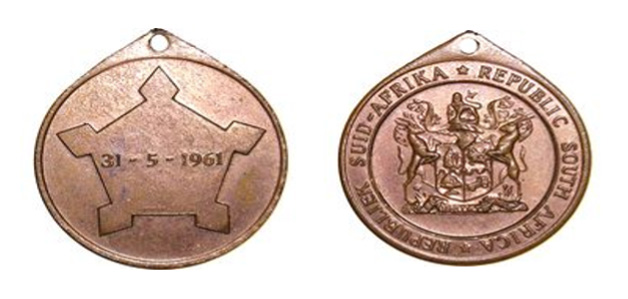
| Obverse/Front: Description | The coat of arms of the Republic of South Africa with supporters, lion crest and motto in inner circle. Wording in Afrikaans around the left and English around the right in outer circle. |
| Obverse/Front Image | See Figure 1 |
| Script: Latin | EX UNITATE VIRES |
| Lettering | REPUBLIEK VAN SUID–AFRIKA | REPUBLIC OF SOUTH AFRICA |
| Reverse/Opposite Image | See Figure 1 |
| Reverse Description | Cape Town Castle rendered in a pentagonal shape. Date in middle of castle outline. |
| Script: Latin/ Lettering | 31 – 5 – 1961 |
| Edge | Plain |
| Mint | Pretoria, South Africa |
These medallions represent a pivotal moment in South African history, namely the 31 May 1961 transition to a republic. Produced by the Pretoria Mint, they were designed to celebrate the National Party’s departure from the British monarchy and the consolidation of white political identity. Although they resemble coins, they were never functional currency.
The correspondence has unlocked the past and a simple inquiry has resulted in successfully resolving the mystery surrounding a family heirloom, satisfying a person’s passion for historical research and ensuring the medal’s historical context is preserved for the future.
Sources
Amsel, L. (2025). “The role of museums in preserving and promoting cultural heritage.” Journal of the West 64: 96-102
Atkinson, R. (2026, June 29). ICOM adopts revised Code of Ethics for Museums [online]. Museums Association Available at: https://www.museumsassociation.org/museums-journal/news/2026/06/icom-adopts-revised-code-of-ethics-for-museums/
International Council of Museums. (n.d.). Object ID [online]. Standards and Guidelines. International Council of Museums. Available at: https://icom.museum/en/resources/standards-guidelines/objectid/
Laidlaw, J. (2026). RSA (pre-1994): Formation of the Republic of South Africa [online]. South African Commemorative Medals. Available at: https://www.southafricanmedals.com
Macala, A. (2025). Heritage object management and conservation in museums. [online]. The Heritage Portal. Available at: https://www.theheritageportal.co.za/article/management-and-conservation-heritage-objects-housed-state-departments-or-supported-bodies
Mutoni Uwase, N. (2025). The role of museums in shaping cultural heritage. Eurasian Experiment Journal of Humanities and Social Sciences 6: 7-11.
Numista Numismatic Database (2026). Formation of the Republic of South Africa Commemorative Medal Documentation [online]. Object Record ID: N#93536. Numista. Available at: https://en.numista.com/93536
Rajan, N. (2024). “The role of museums in preserving and displaying cultural heritage through art”. Shodh Sagar Journal of Language, Arts, Culture and Film 1:1-6.
Randcoin Numismatic Archive (2026). Silver and bronze medallions: Formation of the Republic of South Africa (1961) [online]. Randburg Coin. Available at: https://www.randcoin.co.za/en/item/496-medallion/11109-silver-and-bronze-medallions-formation-of-the-republic-of-south-africa
South African History Online. (2011, March 31). Becoming a Republic and withdrawal from the Commonwealth, 1961 [online]. South African History Online.Available at: https://sahistory.org.za/article/becoming-republic-and-withdrawal-commonwealth-1961