INDIANS AT WAR IN SOUTH AFRICA
By: David Rilley-Harris, Curator, DITSONG: National Museum of Military History (DNMMH)
(Picture: South African Indian Legion Facebook page).
The South African Indian Legion (SAIL) of Military Veterans is a non-profit organisation researching and raising awareness of South African Indian military history. Their relationship with the DITSONG: National Museum of Military History (DNMMH) has facilitated the Museum’s efforts at increasing representation and inclusivity in the Museum exhibits. Through their own dedicated efforts, SAIL will soon commence building a small display room at the Museum commemorating South African Indian military history. They have already installed a memorial plaque on the Museum grounds listing the Roll of Honour relevant to Indians in South African conflicts.
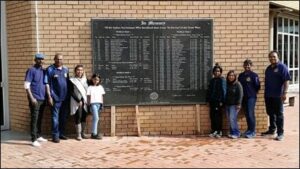
SAIL members at the wall of remembrance at the DNMMH. (Picture: https://www.iol.co.za/sunday-tribune/news/tribute-to-south-african-indians-who-fell-in-both-world-wars-14029323-6bca-4e80-9d46-934ffe8963d5).
These efforts have been spearheaded by Vasudevan (Vinesh) Selvan, a South African Airforce veteran and recipient of the Nkwe Ya Selefera (Silver Leopard) Medal. Vinesh received South Africa’s second highest military honour during Operation Fibre while South Africa was conducting peacekeeping work in Burundi. On his first day having arrived in Bujumbura he responded to the sound of gun shots near his tent. On seeing a wounded Special Forces commander Vinesh soon after found himself facing another member of the Special Forces who had been trying to kill the commander. Vinesh became a target himself and was forced to return fire having been hit in his legs. His actions saved lives and brought a deadly encounter to an end. Today his work includes making sure that Indian South Africans are remembered for their generations of service in South African military history.
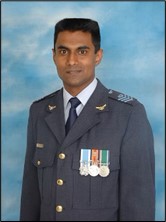
F Sgt Vinesh Selvan NS. (Picture:). (Picture: https://www.samvo.international/post/flight-sgt-vinesh-selvan-ns-south-african-air-force).
The first Indians arrived in South Africa in 1860, brought by the British Empire from India to serve as cheap labour on the sugarcane plantations of Natal (now KwaZulu-Natal). They had been massively underestimated for the value they would add to South African culture forever after. Over time they grew into a community of traders and various types of professionals, and many were notable activists against Apartheid, some of whom would end up as well-respected members of the South African government.
Some Indian South Africans were involved in the Anglo-Zulu War (1879) in non-combatant support roles for the British forces and were on duty as sentries, but they had a more substantial role in South African military history during the South African or Anglo-Boer War (1899-1902). Britain’s Indian Army Contingent was intended as a non-combative element, but they did find themselves in combat against Boer forces. The India contingent comprised three cavalry regiments, four infantry battalions, three field batteries, an ammunition column, and a field hospital. Additionally, seven thousand Indians served in various capacities in remount camps during the war. Notably, Mohandas Gandhi himself organised the Indian Ambulance Corps for the British forces. He was one of many Indian South African stretcher-bearers retrieving wounded soldiers while under fire. It was an experience which helped Ghandi form his philosophy of nonviolent resistance which influenced the anti-Apartheid struggle and India’s independence struggle. During the First World War (1914–1918), both South African Indians and Indians from British-controlled India served. However, due to racial laws, South African Indians were restricted to non-combatant roles, contributing primarily through logistical and medical support. By the end of the war the Indian Ambulance Corps consisted of 660 men. Other Indians were deployed into combat in various arenas including Tanzania and Namibia. In the Second World War (1939–1945), many Indian South Africans volunteered to serve, taking on roles as drivers, engineers, and medics. The Indian Malay Corps suffered significant losses, with 25 killed in action, 11 dying of wounds, 15 dying as prisoners of war, 28 missing and presumed dead, and 384 dying in service. Indian citizens were in combat in the North African campaign as were forces from the South African Union Defence Force. During the Cold War, South African Indians in the South African Defence Force (SADF) faced racial discrimination despite their contributions and were too often overlooked for promotions. Despite this, some still managed to find combat roles and move up the ranks. One man, Warrant Officer Laren Krishna, would become the first ever South African Indian Recce, earning him a place in the country’s most elite military unit. Krishna was descended from the original 1860 Indian South Africans. As a child he would play informal sports alongside the sugarcane fields. In 1984, he volunteered to join the South African Navy and soon found himself in the Special Forces training cycle. He had to withstand severe physical and psychological stresses, qualify as a paratrooper, qualify in handling demolitions, and pass basic medical training, bush warfare training, and urban warfare training. He succeeded, joining 1 Recce and became a Special Forces Operator in 1987. Despite hostility from racist compatriots and harassment which included his telephone being tapped, he retained discipline and became combat active in Operation Moduler. Operation Moduler included the famous Battle of Cuito Cuanavale and ran from 4 August 1987 to 30 November 1987. In 1994, Krishna was involved in the military’s role in keeping the peace during South Africa’s transition.
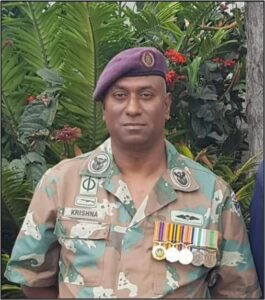
W/O Laren Krishna. The first South African Indian Recce. (Picture: https://risingsunnewspapers.co.za/283135/first-indian-special-forces-commando-called-to-higher-service/).
Today Indian South Africans have roles throughout most of the SANDF but still find themselves too often overlooked for promotion to the higher ranks. For more information on notable Indian South African military contributors, look out for the new SAIL display soon to be constructed in the Brink Hall of the DITSONG: National Museum of Military History.