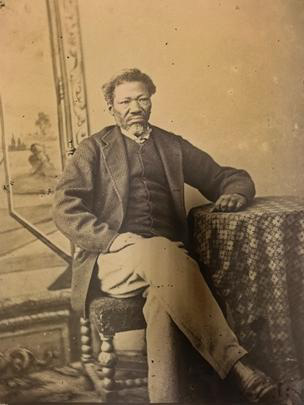
KEEPING A SECRET WHILE RETAINING VIGILANCE
THE ASSASSINATION ATTEMPT ON PRESIDENT PAUL KRUGER
by
Jan van den Bos, Curator: Weapons: DITSONG: National Museum of Cultural History
&
Jaco Schoonraad, Site Curator: DITSONG: Kruger Museum and DITSONG: Sammy Marks Museum
In 1898, the ZAR government bolstered security in front of the Kruger house by doubling the number of sentries and arranging for additional protection within the President’s living room in Church Street West, (now WF Nkomo Street), Pretoria. Special precautions were also implemented to escort President Kruger in his coach between his residence and his office at the government building on Church square.

Figure 1: The South African Republic (Foot) Police (ZARP) in front of Kruger house in 1894. The last two persons on the right, with the darker uniforms are most probably members of the Pretoria Volunteer Corps. The latter provided additional security in the absence of the State Artillery who participated in the Malaboch War. The State Artillery and the police normally guarded the house. The government doubled the number of sentries during the Malaboch War, similar to when reports of President Kruger’s assassination emerged.
(Source: Kr 2638, Kruger collection)
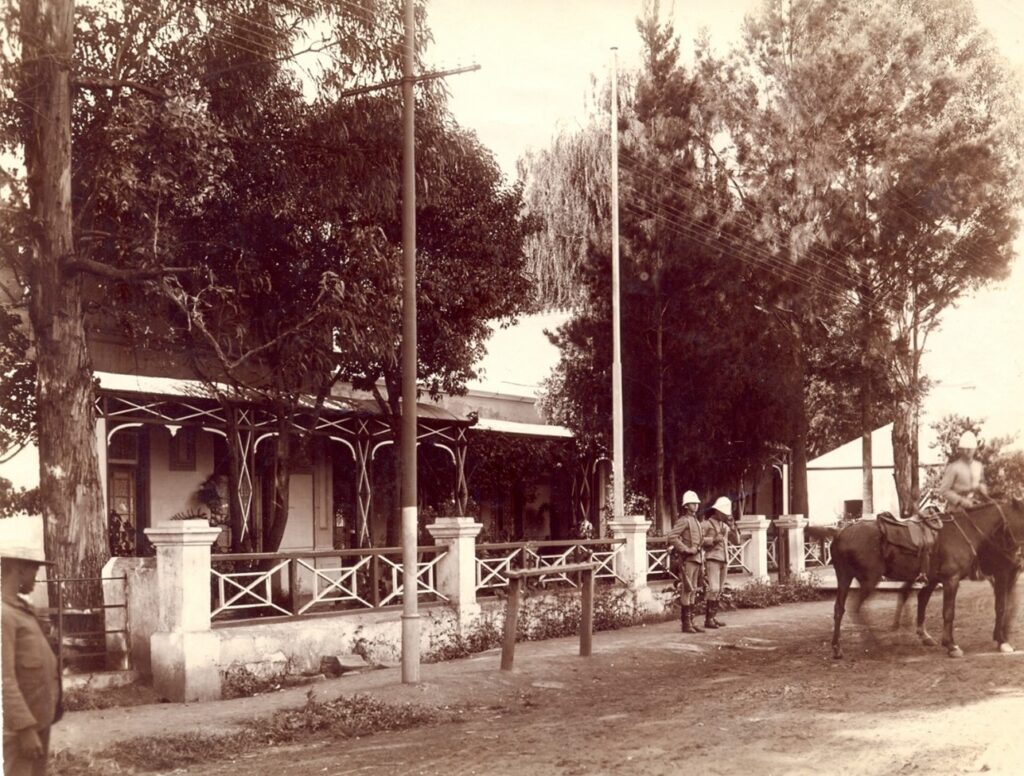
Figure 2: A depiction of tranquillity at the start of 1894, unmarred by the threats of war, with only two ZARP sentries dressed in lighter field uniforms standing watch. The same sense of calm persisted before rumours of an assassination against President Kruger followed in 1896.
(Source: Kr 774-11d, Kruger collection)
Conscious of the safety exercise, only without the detail, President Kruger continued with his daily life. While intimidating letters of death threats against the President accumulated, his youngest son, Tjaart Kruger, the State Secretary, Dr W.J. Leyds, and the Chief of Police, Commandant D.E. Schutte decided to withhold the contents of these letters from the media and the President. Tjaart, aware of his father’s stubbornness, specifically when confronted, also considered the welfare of his mother, Gezina. The political instability after the Jameson Raid and the approaching war against Britain, dominated the South African scene. Media reports of planned death threats against the President would have a devastating effect on his wife, his family and the country.
Threatening letters
The number of threatening letters surged around the time of President Kruger’s fourth presidential election in 1898. While local measures may have curbed some threat reports, they continued to appear in international publications. While Tjaart Kruger successfully intervened in the publication of a death threat report intended for the Volkstem newspaper of 5 February 1889, personal letters and newspaper reports from abroad continued to surface. A French letter states: (translated)
“You (Kruger) are a fool for filing to establish proper laws for the people who come to Transvaal State and are unfit to sit on top of a chair and rule the state. You must die and we have sworn to shoot or dagger you if you are re-elected as President.
Viva la France! The death to President Kruger”.
Reasons behind the death threats against President Paul Kruger
Kruger and his government successfully suppressed the foreign-led uprising during the Jameson Raid of 1895/96. The grievances of foreigners and miners, centered on the protection of individual rights, and opposition to the government’s dynamite monopoly, contributed to the death threats against Kruger.
The raid had a detrimental impact on the trade and commerce sectors, financially affecting citizens across all levels of society. The majority blamed Kruger and his government for the country’s financial decline. Kruger and his partners faced criticism for their handling of the Dutch railway company following the construction of the Pretoria-Delagoa Bay Railway line. Additionally, Kruger’s relentless view on the dynamite monopoly remained a grievance.
The Dutch railway company
President Kruger sought to expropriate the Pretoria-Delagoa Bay Railway Line, which had been primarily constructed by the Nederlandsche Zuid-Afrikaansche Spoorweg Maatschappij (NZASM), a Dutch company. The 1896 rinderpest outbreak, with expenses of over a million pounds, required more revenue. Establishing an independent South African-Delagoa Bay Railway line would secure a consistent revenue stream for the government. Kruger succeeded in the expropriation of the Delagoa Bay Railway line and increased railway tariffs, but these actions also earned him numerous enemies. These enemies believed in the inclusion of other participating parties and held a strong faith in justice. They were opponents who would fight to the death for what they believed was right.
The dynamite monopoly
Kruger’s obvious intention with the dynamite monopoly was to ensure control over key aspects of the country’s economy. The dynamite concession became the cornerstone of the ZAR independence. In contrast to a government monopoly, free trade could offer a solution for establishing an independent dynamite factory with suppliers outside the government sphere. When government renewed the concession in 1897 for another 10 years, justice was compromised, and Kruger became the antagonist. However, Kruger, in a gesture of goodwill, conceded some local representation. The President for instance, granted foreigners limited municipal rights over Johannesburg properties. This was certainly not what the foreigners expected, and undoubtedly, it fell short of all their demands.
The Transvaal Secret Society (Transvaal Secret Service Agents)
Agents of the Transvaal Secret Society, officially known as the Secret Service of the South African Republic, suspected infiltration into state departments, especially after 1896 which became a concern to the safety of the state. During this period, evidence of the assassination attempt on President Kruger also surfaced for the first time.
Edwald Esselen, State Attorney of the South African Republic from 1894 to 1895, and State Secretary W.J. Leyds, recognised the need to investigate rumours of an impending riot near Johannesburg. For this clandestine operation they established the Transvaal Secret Society.
George William Taylor (code name Joseph) and F. Brand were the first two confidential detectives appointed as Secret Service Agents at the Detective Department in 1894. Following the Jameson Raid, additional agents, including Van der Berg, who posed as a diamond prospector, were recruited. By April 1896, six more agents were active across various locations, including South African harbours, Rhodesia (Zimbabwe), Bechuanaland (Botswana), Lisbon, Johannesburg, Natal (KwaZulu-Natal) and the Orange Free State (Free State).
The Secret Service frequently met at the Nationale Bank in Pretoria. On one occasion, President Kruger and his Private Secretary, Jan Eloff, attended a meeting. Prominent members such as T.W. Becket, a Pretoria merchant, W. Verwey, the Chief Engineer at NZASM, J. Boshoff the Treasurer General and Eduard Lippert, the founder of the Modderfontein dynamite factory, regularly appeared at these “secret” meetings. Dr W. Knappe, the first Manager of the Nationale Bank and Herman Militz, co-founder of the Bank were also present at the meeting.
Regular discussions during these meetings included budget debates, financial considerations and allocations to the Free State, as well as espionage matters. The budget increased from £15 000 in 1894 to £80 000 in 1895. In addition to representatives such as Victor Schoenmehl, the Attorney-General of the ZAR, Baron de Matalha (Daniel François Malan de Matalha), and the Consul General for Mozambique, several news agents also attended the meetings and were granted subsidies by the Secret Service. Amongst the local newspapers were Standard and Diggers’ News, Pretoria News, De Volkstem, Ons Land, as well as international German newspapers such as Die Hamburger Nachrichten, Vossische Zeitung, Berliner Neuesle Nachrichten.
During one of these meetings, Commandant D.E. Schutte, the Chief of Police, raised the assassination attempt on President Kruger.
The assassination attempt
A.E. Heyer, a pro-British and anti-Kruger supporter, received several unstamped parcels from what he believed were his critical readers, who sought to challenge the disclosure of information in several of his pamphlets. A Brief history of the Transvaal Secret Service was his fifth revealing publication, disclosing “dark secrets.” It exposed the details of closed-door meetings and named prominent individuals who had attended these secret encounters.
A terrifying incident occurred when Heyer received a parcel containing a live Lee-Metford rifle cartridge from an anonymous source. The accompanying letter instructed him to “blow his brains out.”
On 26 January 1898, Heyer received a letter from one of the most powerful political societies in Germany, expressing their concern about an assassination conspiracy against President Kruger. As much as Heyer disliked the President, he felt obliged to inform the government. On 7 February 1898 Heyer sent a registered letter to Dr W.J Leyds. informing him of the conspiracy against Kruger. The letter states:
Dr LEYDS,
I simply stated what my suspicions were, and what I had personally seen, together with certain strange coincidences during the previous week- In conclusion I offered my services to make further investigations on one condition: that I was to receive no bonus of any kind, however long my services would be required, but that my hotel and travelling expenses be refunded to me.
Dr Leyds answered A.E. Heyer by telegram on 7 February 1898:
Come over at once, expenses will be fully repaid.
When Heyer arrived at the police offices in Pretoria on Monday 14 February 1898, he was first interviewed, in the presence of Dr Leyds, by Mr N.J.H. Fortuin, the confidential clerk to Dr Leyds. Surprisingly the police knew about the assassination rumours on President Kruger. Without revealing their source, Fortuin asked Heyer to assist in tracing the suspects. Obviously, and contradictory to his letter, Heyer refused Fortuin’s offer, citing his discomfort during the police interrogation and his pro-British sentiments.
On 5 February 1898, two detectives, dressed in plain clothes, closely followed and observed both conspicuous suspects. The latter’s dark complexion and shabby clothing immediately drew attention.
The unarmed suspects left Cape Town for Bloemfontein, followed by Johannesburg and Pretoria. They stayed in a boarding house in Johannesburg. In the early hours of 10 February 1898, they departed for Pretoria, armed and newly dressed. Upon arriving at the railway station, they left a small, brand-new suitcase labelled “Cherebourg”, at the cloak room. Followed by the detectives, the two suspects hurried to the Market Square (Church Square), in time for the arrival of President Kruger in his usual closed carriage, only this time, under a stronger escort to attend his first Executive Council meeting after his re-election. A large crowd gathered to cheer and get a glimpse of the President.
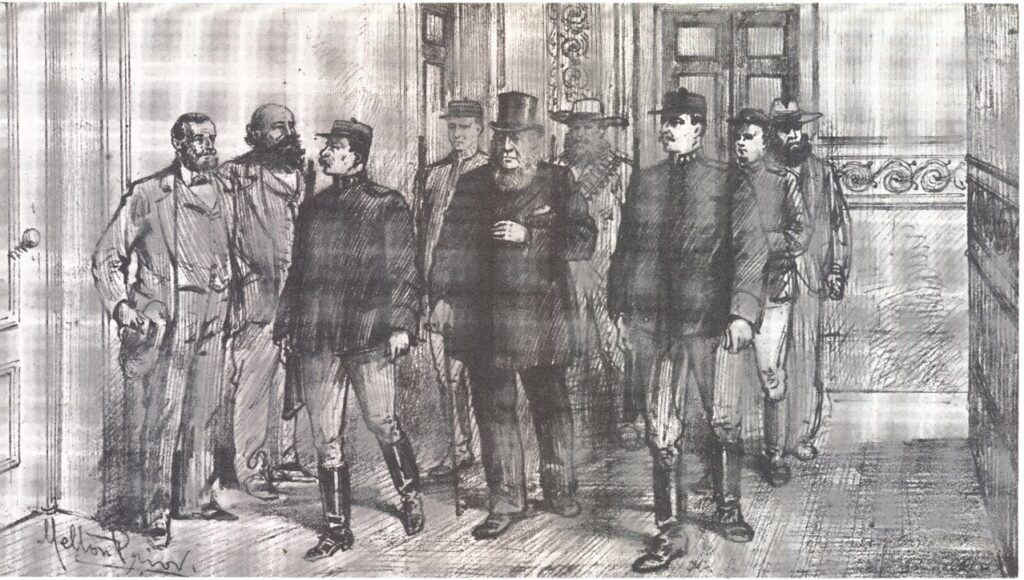
Figure 3: A sketch by Melton Prior of President Kruger and his personal Police Guard, leaving the Executive Council Chamber at the Raadsaal in 1896. The assassination attempt in 1898 happened when Kruger arrived at Church Square for an Executive Council meeting, a day after his fourth presidential election
(Source: Balkema (ed), A.A., Pictorial Africana, p. 207.)
Without warning, one of the suspects drew a small, loaded revolver from his trouser pocket, waiting for the right moment to fire. The nearby detectives acted swiftly, handcuffing the two men. Amidst the cheering of the crowd, the incident nearly attracted attention when the two villains attempted to scream. Once past the crowd, the two were quickly escorted into a Cape cart and driven to the Police Headquarters.
After a thorough search the police confiscated two revolvers – one fully loaded and the other with only three unused cartridges – along with a small dagger with a very sharp blade. A piece of paper with the instructions: “Square, straight down Market Street – 12 o’clock” provided further evidence of a bigger power behind the assassination conspiracy. Over £14 in silver and gold was seized, while personal belongings, including a pocketknife and a railway ticket, were returned to the suspects.
The two suspects acknowledged being foreigners and revealed their countries of citizenship but refused to give their names. The taller individual was from Palermo in Sicily, Italy, while the other, a Frenchman, hailed from Léon, in south-western France. Both had embarked on the RMS Dunvegan Castle to Cape Town.
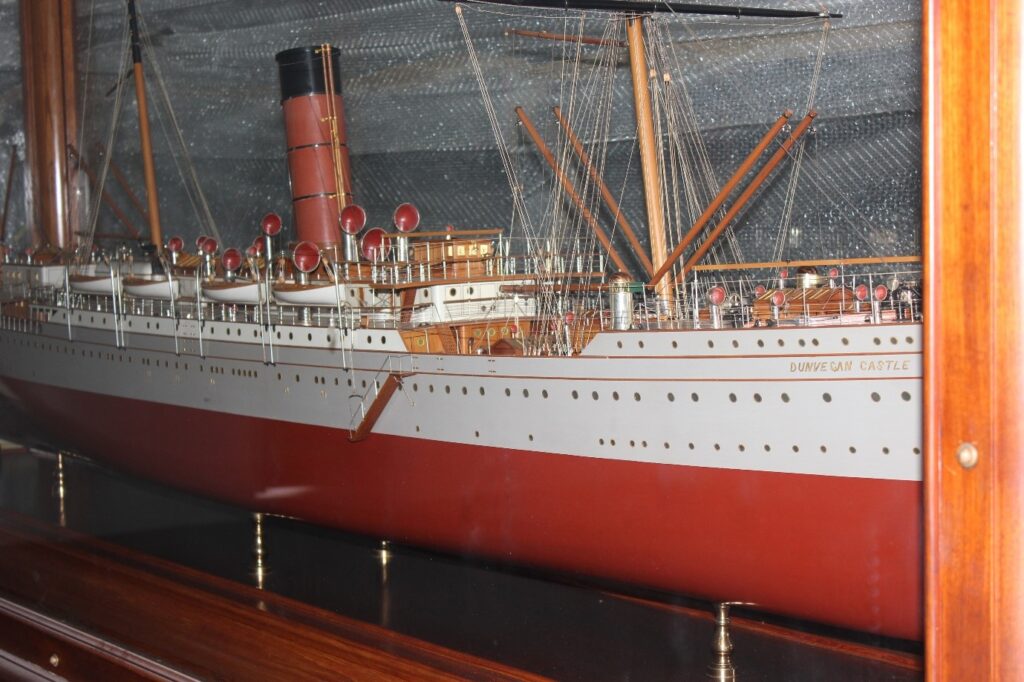
Figure 4: A model of the RMS Dunvegan Castle presented to President Kruger by Sir Donald Currie. Ironically, it was the same ship on which the two villains embarked for their journey to South Africa.
(Source: Kr 2717, Kruger collection)

Figure 5: The .455 Webley Revolver, MK III. According to its provenance, the weapon belonged to a Seldheim, most likely one of the two villains associated with the assassination attempt on President Kruger.
(Source: HG 5656, Weapon collection)
Police authorities decided to withhold the entire incident from President Kruger and deported the two suspects across the border into Portuguese territory. A Transvaal Secret Agent was discreetly assigned to follow them, while the police worked to uncover the masterminds behind the assassination attempt.
Conclusion
The provenance of an object enhances significance, meaning and value. Without provenance, it would not be possible to connect events and objects to one another. It is crucial for museum professionals to provide as much information as possible about an object to preserve its historical context.
The Secret Service continued to operate under the watchful eye of Jan Smuts, the State Attorney of the ZAR in 1898, until its dissolution in 1900.
Sources
Balkema (ed.), A.A., Pictorial Africana: A story of old South African paintings, drawings and prints to the end of the nineteenth century with a biographical dictionary of one thousand artists. Cape Town,1975.
Heyer, A.E., Facts of the attempted assassination of President Kruger in February 1898. First edition, WM Taylor, Cape Town, 1900.
Van den Bergh, G.N., Secret Service in the South African Republic 1895-1900, in Military History Journal, 3(2), December 1974.
National Archives of South Africa
TAB: Library, Pamphlet, P 343, Reference 8303. A Brief history of the Transvaal Secret Service System. From its inception to the present time, its objects, its agents, the disposal of its funds and the result as seen today. War against Great Britain, third edition, Cape Town. Printed and published by WM Taylor 11 Church Street, 1899.