MEMORIAL GARDEN PERMANENT DISPLAY PRODUCED AT THE DITSONG: NATIONAL MUSEUM OF MILITARY HISTORY
By: Allan Sinclair: DITSONG: National Museum of Military History
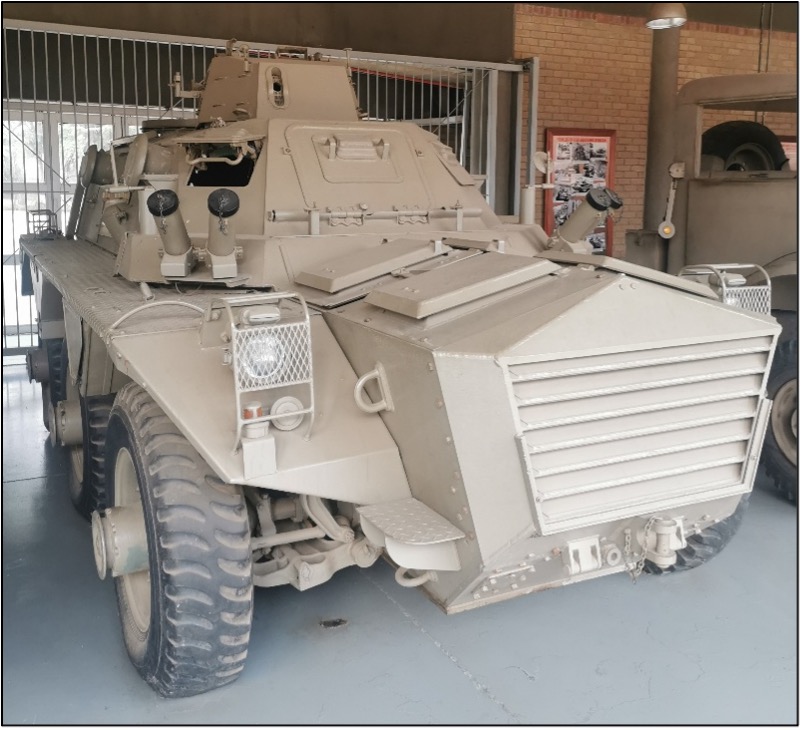
When the DITSONG: National Museum of Military History (DNMMH) was officially opened in August 1947, Field Marshal J. C. Smuts, Prime Minister of South Africa at the time, referred to it as a memorial to what he termed “…the greatest united effort our country had been called upon to produce…”.
This effort was South Africa’s involvement in the Second World War (1939 – 1945).
Members of the public have frequently requested that the DNMMH create a Garden of Remembrance to allow for the scattering of loved ones’ ashes, upon request. In response, the Delville Wood Commemorative Trust offered to sponsor the creation of such a memorial garden. The garden will incorporate thirteen grave markers from the ‘Graves and Memorials Collection’ housed within the DNMMH.
The Delville Wood Commemorative Museum Trust was originally established in the early 1980s and its present form on 14 August 1995. The mission of the Trust is to actively support the development of the Museum at Delville Wood and its image.
Mr Steve van Blommestein, a professional landscaper, was contracted by the Trust to design and create the memorial garden at the DNMMH. The garden bed located at the immediate entrance to the Museum from the car park, was selected for the memorial garden. The metal crosses were the temporary grave markers used on the battlefields of the Somme Offensive of 1916. These historic markers were sandblasted and powder coated in white to be used in the garden. Ophiopogon japonica (Mondo Grass) was planted as groundcover in between the crosses while Tradescantia pallida (Purple Heart) shrubs were planted along the back of the bed next to the library building. A bench with a memorial plaque which commemorates the life of the late Mr Jonathan Graham Frank, a frequent visitor to the Museum, has been placed on a paved area for silent reflection. The Garden is enclosed with a boundary chain-and-post fence.

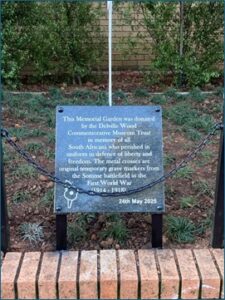
The Trust also provided a granite plaque with the following engraved on it:
This Memorial Garden was donated by the Delville Wood Museum Trust in memory of all South Africans who perished in uniform in defence of liberty and freedom. The metal crosses are the original temporary grave markers from the Somme Battlefield in the First World War (1914 – 1918).
24 May 2025.
During the First World War (1914 – 1918), soldiers were typically buried where they fell or close by. The sheer volume of casualties, and the fact that units were at times under constant fire, meant this was often carried out very quickly. Graves were marked for later identification, often with whatever was available – sticks, rifles pushed into the ground or makeshift wooden or metal crosses. Such was the scale of battlefield deaths on the Western Front that crosses were mass-produced and shipped to the front. Of the surviving examples, many are now housed in churches, but others are in museums, memorial halls, private collections and even schools. The DITSONG: National Museum of Military History is fortunate to have a number of these metal grave markers, shaped in the form of crosses, in its ‘Graves and Memorials Collection’.
At the conclusion of the First World War, the Imperial War Graves Commission, today known as the Commonwealth War Graves Commission, was given the responsibility to provide for permanent graves in permanent cemeteries. The Commission, originally established by Royal Charter in 1917, commemorates 1.7 million war dead from the Commonwealth nations in over 148 countries worldwide. Its work is guided by four fundamental principles established in 1920, namely:
- That each of the dead should be commemorated individually by name either on a headstone over a grave or by an inscription on a memorial if such a grave is unidentified.
- That the headstones and memorials should be permanent.
- That the headstones should be uniform; and
- That there should be no distinction made on account of military or civil rank, race or creed.
Throughout this process, the temporary grave markers were subsequently replaced with the Portland Stone head stones designed by Sir Edwin Lutjens.

Lutjens head stones at Arques-La-Batailles Cemetery, near Dieppe, France.
The DITSONG: National Museum of Military History is grateful to the Delville Wood Commemorative Museum Trust for providing the necessary funds to produce this Memorial Garden. The Garden was also developed in preparation for the 110th Anniversary of the Battle of Delville Wood which will take place in July 2026.
References
R.E.B. Coombs, Before Endeavours Fade: A guide to Battlefields of the First World War 7th ed (Battle of Britain Prints International, London, 1994).
War Graves of the British Empire (Imperial War Graves Commission, London, 1927).
The War Dead of the Commonwealth: Cemetery and Memorial Registers (Commonwealth War Graves Commission, London, 1958 – 1960).