REDISCOVERING STEGOPTERUS: MUSEUM SPECIMENS REVEAL UNEXPECTED DIVERSITY IN A SOUTH AFRICAN ENDEMIC BEETLE GENUS
By: Werner Strümpher: Curator: DITSONG: National Museum of Natural History, Pretoria, South Africa
Think all major scientific discoveries happen out in the wild? Think again. Some of the most surprising breakthroughs are hiding in plain sight — inside museum drawers. That’s exactly what happened with a little-known group of beetles from South Africa called Stegopterus.
Until recently, only four species of Stegopterus were known. But after a deep dive into historical museum collections — alongside newly collected field specimens — researchers have uncovered at least 15 distinct species, 11 of them completely new to science.
First described in the early 1800s, Stegopterus had largely faded into obscurity. That changed with a comprehensive taxonomic revision led by Enrico Ricchiardi (Turin, Italy), Prof. Renzo Perissinotto (Nelson Mandela University, Gqeberha), and myself. Our study, published in African Invertebrates on 26 February 2025, brought this overlooked genus back into the scientific spotlight — a rediscovery made possible largely through specimens preserved in natural history museums.
What makes this finding even more remarkable is that every known Stegopterus species is endemic to South Africa’s Western Cape — meaning they occur nowhere else on Earth. This region, part of the globally significant Cape Floristic Region, is one of the most ecologically rich and biologically diverse areas on the planet. Each species has an extremely limited range, restricted to specific habitats within the Fynbos Biome. The pattern of local evolutionary diversification seen in Stegopterus mirrors broader trends observed in many of the Cape’s extraordinary plants and animals.
Incredibly, many of the newly discovered species are known from just a single location — or even a single specimen. Nine of the 11 were identified by carefully examining previously overlooked museum specimens, some collected more than a century ago. This highlights two important truths: even well-studied regions can harbour hidden biodiversity, and natural history museums are invaluable archives of life on Earth. In certain instances, these specimens represent the sole proof of a species’ existence.
Our revision combined traditional taxonomic methods with a bit of scientific sleuthing. We re-examined historical material from both South African and international collections and conducted targeted fieldwork in key fynbos habitats. By analysing fine morphological details — including head and leg shapes, wing patterns, and male genitalia — we were able to separate and describe the various species.
Yet, there’s still much more to uncover. Large areas of the Western Cape remain underexplored, and the evolutionary relationships between Stegopterus species are not yet fully resolved. For most species, females remain undescribed, and little is known about their ecology or behaviour. Mapping their distributions is now a top priority, especially in regions increasingly threatened by agriculture and urban development.
Thanks to a blend of fieldwork and museum research, we now know that the Cape’s beetle diversity is far richer than previously imagined. And it all began with specimens that had been waiting quietly in drawers — some for over 100 years — for someone to take a closer look.
Who knows what other secrets are still hiding in our collections?
Read the full study in African Invertebrates:
https://doi.org/10.3897/AfrInvertebr.66.140593
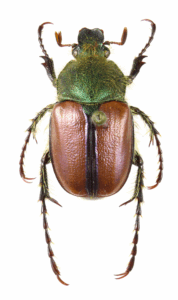
Stegopterus suturalis is the type species of Stegopterus. Originally described in 1883 by Gory and Percheron as Trichius suturalis.
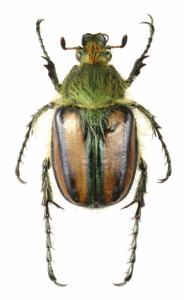
Stegopterus vittatus (Fabricius, 1775) is the best-known species in the genus. Its distribution has been well- documented across the lowland regions of the Western Cape, extending from Cape Point in the south to Lambert’s Bay on the West Coast.
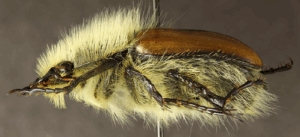
Side view of Stegopterus endroedyi, a newly described species named after the well-known Hungarian entomologist Sebastian Endrödy-Younga, who collected these specimens in 1978 in the Groot Swartberg mountains near Oudtshoorn, South Africa.

Top view of Stegopterus hexrivieri, a species named after the Hex River area (“Hexrivier” in Afrikaans), where the only known specimen was found. It was collected in 1899 by an unknown collector.
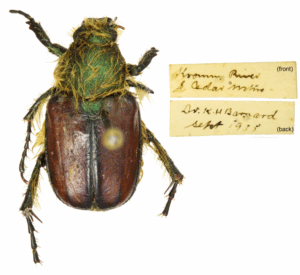
Top view of Stegopterus kromrivieri, one of the newly described species. This specimen was collected in 1935 near Kromrivier in the Cederberg Mountains, South Africa, by Dr. Keppel Harcourt Barnard (1887–1964), a renowned zoologist and mountaineer.
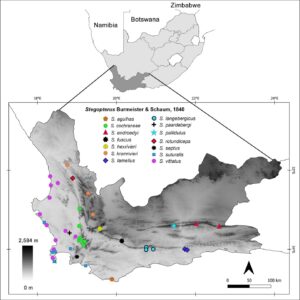
Distribution map of Stegоpterus species occurring in the Western Cape, South Africa.