SOUTH AFRICAN CASUALTIES IN NORMANDY 1944
Allan Sinclair
DITSONG: National Museum of Military History
The DITSONG: National Museum of Military History had previously received an enquiry from Mr Colin MacMillan, an official guide of battlefield tours in and around Normandy, France. This enquiry has possibly led to the uncovering of a “hidden” South African story of the Second World War (1939 – 1945).
In the course of his tours Mr MacMillan came across the graves of certain members of the Union Defence Forces located in the Commonwealth War Cemeteries of the Normandy area. Most of them were found in the St Desir Cemetery between Caen and Liseux. This puzzled him as, although he was aware of the South African involvement in the campaigns of North Africa and Italy, he had no knowledge of any input from our country in Northwest Europe insofar as ground forces were concerned.
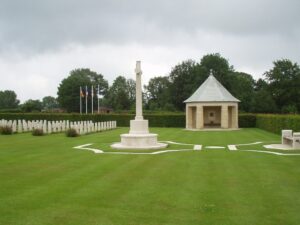
St Desir War Cemetery, Calvados, France https://www.cwgc.org/visit-us/find-cemeteries-memorials/cemetery-details/2005001/st-desir-war-cemetery/
The following list of names and details were provided in the correspondence:
- Harris, W. Pte, Number C/287765, Cape Corps, SA Forces, died 13/05/1944.
- Gawe, S. Pte, Number N/21410, Native Military Corps, SA Forces, died 12/03/1944.
- Motshoneng, Joki. Pte, Number N/9009, Native Military Corps, SA Forces, died 27/03/1944.
- Mangena, W. Pte, Number N/1817, Native Military Corps, SA Forces, died 05/04/1944.
- Abrahams, Christian. Pte, Number M/11968, Indian and Malay Corps, SA Forces, died 02/08/1944.
As observed, the dates of death, with the exception of Pte Abrahams who is listed last, pre-date the Normandy invasion by a couple of months and Mr MacMillan had begun to wonder if they had been in transit either by air or sea at the time of death. He was also keen to obtain any records of the South African involvement in Northwest Europe to use as material for his tours of the Normandy battlefields.
This enquiry raised some interesting points. There had never been any official South African presence in Northwest Europe at any time during the Second World War, although many South Africans served in the British Armed Forces, either in their own capacity or seconded to by the Union Defence Forces, during the campaign of 1944/45. The South Africans listed by Mr MacMillan, however, were all members of what was then referred to as the Non-European Army Services (NEAS), which comprised the SA Cape Corps, the Indian and Malay Corps and the SA Native Military Corps. It was, therefore, unlikely that, considering the racial climate of the time, any NEAS members would have been assigned to serve in Northwestern Europe.The Union Defence Forces’ Roll of Honour provides a crucial answer, as all five South Africans are listed as D-POW, indicating that they died as prisoners-of-war.
Most members of the NEAS were taken prisoner during the North African Campaign, a large majority went into the bag when the 2nd South African Division surrendered at Tobruk in June 1942. Many remained in North Africa and were put to work in the harbours by the Axis. However, Gleeson writes that, by October 1942, more than half of the NEAS POWs had been moved to Europe where they were forced to work in labour gangs in Germany and other areas under German control. Their tasks included road and rail construction and the digging of trenches along the extensive German defence lines. It is possible that the individuals in question had been put to work on the defences constructed along the Normandy coast.
There are many other such “hidden” stories involving South Africans in both the First and Second World Wars. It is through answering such enquiries that curators at the DITSONG: National Museum of Military History are able to come across them. However, this is merely the tip of the iceberg. The Museum is indebted to Mr MacMillan for drawing our attention to this most interesting discovery.
References
Gleeson, I, The Unknown Force, (Johannesburg, Ashanti, 1994).
Roll of Honour, 1939 – 1945, (In the Archives of the SA National Museum of Military History).