THE FRANCE–SOUTH AFRICA ARMS RELATIONSHIP DURING APARTHEID
By: David Rilley-Harris, Curator, DITSONG: National Museum of Military History
(Photo: DITSONG: National Museum of Military History).
From the 1960s onward, South Africa has had an arms trade relationship with France, which has often been clandestine and occasionally mired by scandal. Several displays at the DITSONG: National Museum of Military History display French items that have occasionally drawn questions from visitors to the museum. The France-South Africa connection was largely formed in the wake of Britain retreating from its military relationship with South Africa.
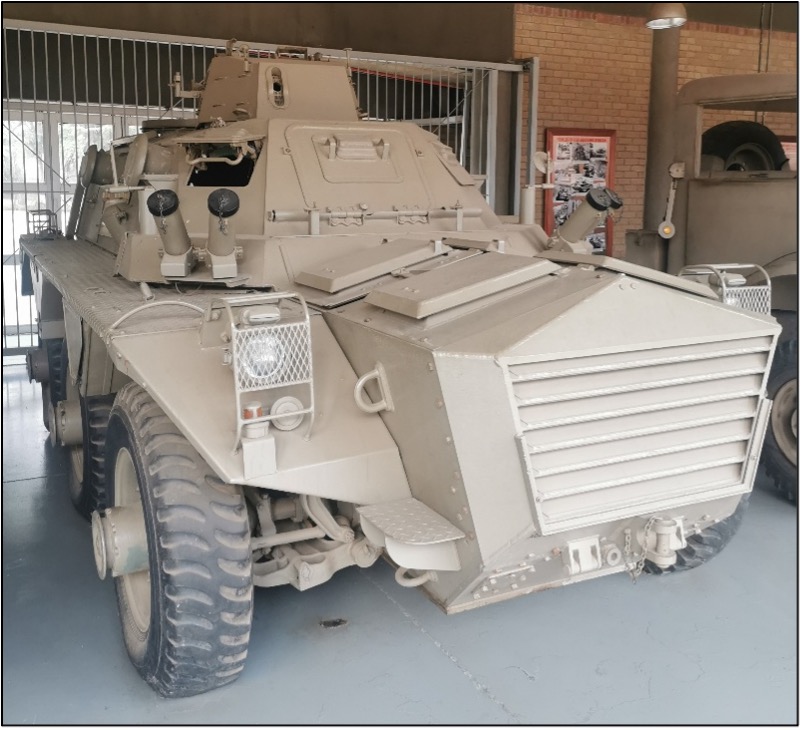
During the Second World War, South Africa was still very much a part of the British Empire and was utilised as a usefully distant yet well-developed territory for the Allies. South Africa housed prisoners of war, refugees, was a breadbasket, and was also developed into an improved production facility to serve Allied needs. When apartheid began three years after the end of the war, South Africa would remain largely dependent on Britain for military equipment through the 1950s and 1960s. The 1960s, however, was a major transitional period for the country as apartheid was making South Africa an increasingly pariah state and domestic resistance to apartheid was growing and becoming more militant. The 1960 Sharpeville Massacre drew severe international attention placing the apartheid regime at a crossroads as British support began to wane. Britain could not ignore the presence of British military type equipment in the hands of the South African police at the massacre. This included British Saracen armoured cars and Sten submachine guns.
(Photo: DITSONG: National Museum of Military History).
South Africa withdrew from the Commonwealth and became a Republic in 1961, and in 1963 the United Nations declared an arms embargo on South Africa. It was a soft embargo being voluntary, but it was a clear message to the government that they would have to begin turning away from apartheid policies or stand more alone. In 1964, South Africa created an Armaments Production Board to increase independent production capacity but to also seek out new import options. PW Botha, then Minister of Defence, visited Portugal and France to investigate new options for South Africa. The French system inspired the founding of the Armaments Development and Production Corporation (Armscor) to produce weaponry and take responsibility for arms imports and exports. By this time, South Africa and France had already set up a relationship where South Africa would provide uranium to France and gain access to French weapons and technology. This also marked the early period of South Africa’s development of its own nuclear weapons program. The apartheid government’s stated concern about a “total onslaught” related to a French concept of “total strategy”, which was developed in the same period.
Apartheid-derived cheap South African labour allowed France to acquire cheaper uranium from South Africa, which came to make up a substantial portion of French uranium imports in the 1960s and 1970s. The French motivation for dealing with South Africa was mostly influenced by the Cold War wherein South Africa was the largest capitalist producer of uranium. Around the same time, France was supplying roughly half of South Africa’s conventional military needs and probably helped set up uranium conversion plants here, possibly at Zuurbekom and later at Pelindaba. France would ultimately assist in the establishment of the Koeberg nuclear power plant as well. Due to apartheid and United Nations sanctions, France and South Africa discreetly proceeded with their trading but the relationship between the two countries was increasingly obvious internationally. Between 1967 and 1970, the Nigerian Civil War saw France and Britain supporting opposing sides, with South Africa apparently standing with France, at least politically.

(Photo: DITSONG: National Museum of Military History).
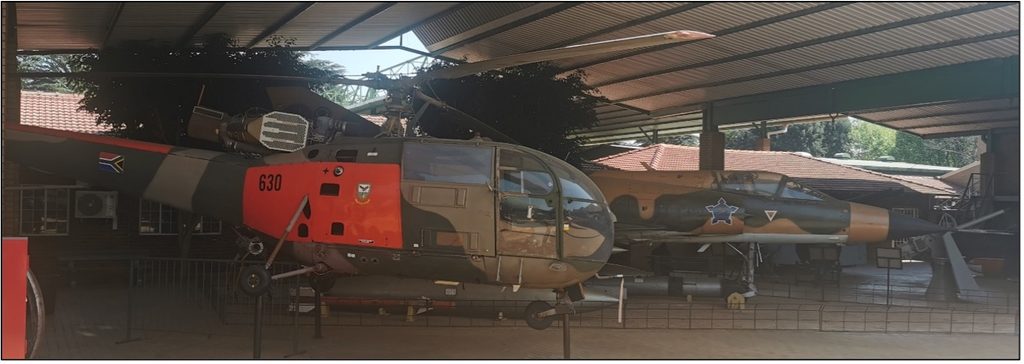
By 1970, France had become South Africa’s largest supplier of military aircraft, which included dozens of helicopters. South Africa also became the third country licenced to build the Mirage III after Switzerland and Australia. At about the same time, South Africa purchased three Daphne-class submarines from France. As pressure built on the apartheid regime, so did it build on France’s relationship with South Africa. Combined with concerns over nuclear weapons test cooperation between the countries, the United Nations passed a more stringent, now mandatory, arms embargo against South Africa in 1977. In response, Armscor was expanded and its staff complement in Paris was reduced from about 200 to about 20. Rather than signalling the end of the France-South Africa relationship, these adjustments appear to have been intended to allow the partnership to continue in a more discreet manner.
The 1980s saw a host of clandestine arms trades between France and South Africa. This included the sale of 66 French Puma helicopters, some of which were converted in South Africa to the Oryx helicopters used in the Angolan Civil War. Four Oryx helicopters flew the new South African flag over Nelson Mandela’s inauguration. South Africa is suspected to have helped France gain access to SAM-7 missiles with false Soviet markings to supply to the National Union for the Total Independence of Angola (UNITA) in their fight against the People’s Movement for the Liberation of Angola (MPLA). In one scandal, France provided South Africa in 1988 with newly developed Mistral air defence missiles to be combat tested in Angola. Testing the missiles in Angola would prove them in combat and increase their value to France as an export. By this time South Africa had developed its first deliverable nuclear weapon.
By the 1990s, the apartheid regime was under overwhelming international pressure having secretly developed nuclear weapons, and with the end of the Cold War, having removed much clandestine justification for cooperation with South Africa. Mounting international public support for apartheid resistance and domestic resistance to apartheid brought about the country’s first democratic election in 1994. South Africa nonetheless initially maintained high enough military spending that it would continue to account for most of the military spending in sub-Saharan Africa. Denel was established under the Ministry of Public Enterprises to handle further domestic production, but Armscor continued under the Ministry of Defence to handle procurement. A few years into South Africa’s liberation a new scandal would break in an arms deal involving France and South Africa.
Sources:
Dunne, J. P. “The Making of Arms in South Africa.” The Economics of Peace and Security Journal 1, no. 1 (2006).
Konieczna, A. “Nuclear Twins: French-South African Strategic Cooperation (1964–79).” Cold War History 21, no 3 (2021): 283-300.
United Nations Security Council. Resolution 418 (1977), Adopted by the Security Council at Its 2046th Meeting, on 4 November 1977. New York: United Nations, 1977. https://digitallibrary.un.org/record/66633?ln=en&v=pdf.
Van Vuuren, H. Apartheid Guns and Money: A Tale of Profit. Hurst & Company, 2018.