THE SEXTON: SELF-PROPELLED 25-POUNDER GUN
By: Michael Tobolo, Junior Curator, DITSONG: National Museum of Military History
Introduction
The Sexton S P 25-pounder gun was developed when the British and Canadian Armies recognised the need for a mobile artillery piece that could keep pace with tanks across all terrain. In the era of cavalry brigades and cavalry divisions, such mobile artillery was essential to provide constant fire support.
The Canadians realised that continuing production of the Ram and later the Grizzly tanks was unnecessary, simply because the United States was already manufacturing sufficient numbers of Sherman tanks. As a result, Canadian factories shifted their focus to producing the Sexton tank. This self-propelled artillery piece was built on the Canadian Ram tank chassis – derived from the American Sherman – and armed with a 25-pounder gun fitted with a muzzle brake. The SP version offered the same performance as the towed gun, but with the advantage of being able to move wherever tanks could operate. After successful trials in Canada and further testing by the British Army, the vehicle was officially adopted and given the name “Sexton” – al little inspired by the church custodian or deacon, reflecting its role as a self-propelled gun.


| Canadian self-propelled 25-pounder Sexton gun (Source: https://en.wikipedia.org/wiki/Sexton_%28artillery%29). | Object 63 – Sexton self-propelled gun (Source: https://theddaystory.com/d-day-in-80-objects/object-63-sexton-self-propelled-gun/). |
Development History
After the mass production of the M4 Sherman tank by the Americans between 1942 and 1945, Canada shifted its focus to the Sexton self-propelled 25-pounder gun. The aim was to supply the British Army with a mobile artillery piece. Canada initially set out to produce the Ram tank, based on the M3 Lee chassis, and later the Grizzly, derived from the American M4 Sherman, to complement US medium tank production.
The Sexton was designed in 1942 and built by the Montreal Locomotive Works (MLW), a Canadian railway locomotive manufacturer and subsidiary of the American Locomotive Company. MLW, known for producing both steam and diesel locomotives, operated between 1883 and 1985, with its headquarters and main factory located in the Hochelaga-Maisonneuve district of Montreal.
Following trials by the Canadian government, the first prototype was completed on 23 June 1943 and shipped to the United Kingdom for further trials. The British Army formally accepted it the same year and named it the “Sexton” following the tradition of naming self-propelled guns after ecclesiastical titles such as the Bishop and the Deacon.
An initial order of 300 Sextons was placed by the UK in 1943. Variants were distinguished by their origins: the Ram-based self-propelled gun became known as the Sexton Mark I, while the Grizzly-based version was designated the Sexton Mark II. Between 1943 and 1945, MLW manufactured 2,150 Sextons for both Canadian and British forces. The Sexton entered service in 1943 and proved to be a highly successful design, remaining in British Army use until 1956.

Canadian railway locomotive manufacturer Montreal Locomotive Works (Source: https://www.youtube.com/watch?v=87rB34NniDk).
Specifications
Type: Self-propelled gun
Mass: 25 long tons (approximately 25,400 kg)
Length: 25 ft 1in (6.12m)
Width: 8ft 11 in (2.72m)
Height: 8ft (2.4m)
Crew: 6 (Commander, driver, gunner, gun layer, loader, wireless operator)
Elevation: +40º to -9º
Armour: 15-32mm (0.59-1.26in)
Main armament: 25-pounder Ordnance (87.6mm) MK II
Secondary Armament: Two 0.303in (7.7 mm)
Engine: 400hp (298kw) continental R 975 Cylinder radial gasoline
Operational range: 125 miles+ (200km)
Maximum speed: 25 mph (40km/h)

Tank production underway at the Montreal Locomotive Works (Source: https://www.communitystories.ca/v2/wwii-came-to-bell-island_seconde-guerre-mondiale/gallery/tank-production-at-montreal-locomotive-works/)
Service History
The Sexton was first used in combat by the British Eighth Army in Italy, and later took part in the invasion of France, the Battle of Normandy, and the North-West European campaign.
During Operation Neptune (the seaborne phase of the Normandy landings on 6 June 1944), Sextons were even ordered to fire at enemy aircraft, though their fire was largely inaccurate and had little effect. The Normandy landings, part of Operation Overlord, marked the largest seaborne invasion in history. This operation, which combined land, sea, and airborne forces, ultimately led to the liberation of France and the collapse of Nazi control, ending with Germany’s surrender on 8 May 1945.
The Normandy landings, carried out by combined Allied forces advancing from both the north and south of France, along with the French Resistance and the Free French forces in London, ultimately led to the liberation of France. This was followed by a complex period of both celebration and unrest.
A wide range of artillery units were equipped with Sextons at different times, including the 1st, 2nd, 3rd, 5th, 6th, and many others up to the 153rd Regiment of the Royal Artillery, with both British and Canadian forces employing them for indirect fire support.
After World War II, the 1st and 2nd Indian Field Artillery Regiments also used Sextons. The 6th South African Armoured Division deployed them in Italy between 1944 and 1945, eventually replacing them with the American-built M7 Priest when the division was transferred to the US IV Corps of the Fifth Army.
Sexton Mk II (early) self-propelled gun passing through the streets of Putanges-le-Lac, Normandy, 20 August 1944 (Source: https://www.facebook.com/100021421346688/posts/british-sexton-ii-self-propelled-gun-drives-through-the-shattered-village-of-put/1560468124677217/
Conclusion
The withdrawal of the Sexton from service by the British and Canadian forces in the mid-1950s marked the end of its operational life, after having remained in use long after the Second World War. Due to the high cost of scrapping, many vehicles were dumped in disposal sites.
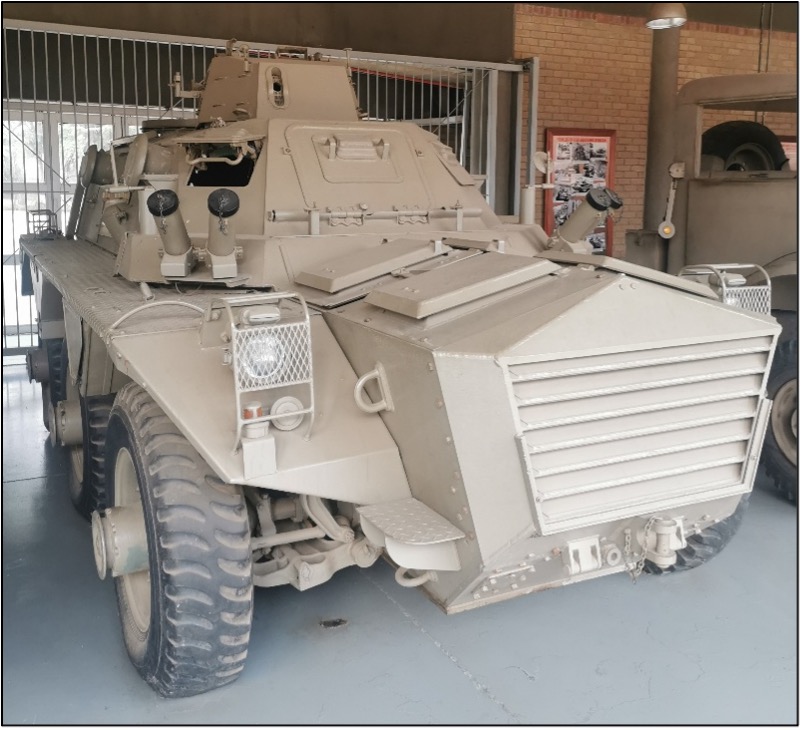
Today, a number of Sextons survive in museum collections, among them the DITSONG National Museum of Military History in Johannesburg, South Africa.
References
1. Chamberlain & Ellis, 2004. British and American Tanks of World War II, pp. 139, 176.
2. Henry, Chris. 2002. The 25-pounder Field Gun 1939–72. New Vanguard 48. Oxford: Osprey Publishing. p. 39. ISBN 9781841763507.
3. Livesey, Jack (2007). Armoured Fighting Vehicles of World Wars I and II. Southwater. pp. 106–107. ISBN 978-1-84476-370-2.
4. Profile AFV Weapons 13, “Ram and Sexton”.
5. Stacey, C. P. (1970). Arms, Men and Government: The War Policies of Canada, 1939 – 1945 (PDF). The Queen’s Printer by authority of the Minister of National Defence. pp. 513–514.