WARTIME MEDICINES
By: David Rilley-Harris, Curator, DITSONG: National Museum of Military History (DNMMH)
Until the 1890s, most medicines were derived from plants and plant extracts. Thereafter, medicines were increasingly made through inorganic chemical processes, allowing them to be produced more affordably and on a larger scale. Today, medicines still include a mixture of industrially processed and more “natural” medications. The following are examples of medicines from the DITSONG: National Museum of Military History (DNMMH) collection, which were used in the 19th and 20th centuries..

Refined Peppermint Oil, Dill Oil, Cinnamon Oil, and Bergamot Oil. (Picture: DNMMH).
The first group of four may resemble common culinary ingredients, but each had a distinct medical purpose. “V. Mane Fils” was a French company founded in 1871 which still exists under the name “Mane SA”. They provided the above oils for military medical purposes in the late 19th and early 20th century. Today, the company is better known for manufacturing flavours and fragrances. Refined peppermint oil is still used in medicine to treat digestive ailments, headaches, nausea, and offering mild pain relief. Dill oil was used into the early 20th century to treat bloating and gas. It was useful for soldiers suffering from dysentery or poor diet which can result from wartime conditions. Cinnamon oil known for its antimicrobial properties, was also used to address digestive problems related to low-quality food supplies. It was used for gastrointestinal ailments and was also a mild pain reliever. The Bergamot oil pictured was produced by a very similar French company called Faure-Bertrand Fils & J. Dupont. Bergamot is extracted from citrus fruit and is more recognised today as the flavouring in Earl Grey tea. It could be used as a digestive aid, but it also possessed antiseptic and antibacterial properties and was sometimes added to military-issue soaps or balms.
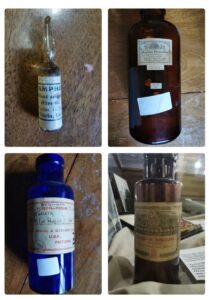
Olive Oil, Morphine, Opium, and Quinine. (Picture: DNMMH).
Olive oil has been used as a medicinal remedy since ancient times and continues to be utilized today. Medical-grade olive oil is beneficial for wound care, serves as a mild laxative, and was occasionally used in field hospitals to sooth dry or irritated skin. Morphine is probably the most well-known battlefield medicine and is used to manage severe pain. The blue bottle (pictured above) held veterinary powdered opium. It was a sedative and relieved pain in military horses such as those in the cavalry or in supply logistics. Quinine has been one of the most crucial military medicines, especially across the African continent. It was used both to prevent and treat malaria, which posed a significant threat to military forces in tropical regions. Malaria had been devastating to South African forces in German East Africa during the First World War, but the problem was largely mitigated during the Second World War with the use of Quinine. One tablet daily was recommended for prevention, and six tablets were taken per day for treatment.

Anti-fungal powder, Ammonia spirits, Mustard leaves, and a wartime tablet tin. (Picture: DNMMH).
The Anti-fungal powder pictured dates to the mid-20th century. It was used to treat fungal infections such as athlete’s foot and ringworm, which were particularly common in hot and humid environments. The Ammonia spirits are also known as smelling salts. They were a stimulant which could revive fainting soldiers. It was also alkaline which helped with insect bites and stings. It could slightly neutralize certain venoms, such as those from bees or certain scorpions. The 19th century practice of putting it on snake bites was later found to be ineffective and potentially dangerous. Mustard leaves, pictured above as “Rigollot’s Paper”, were applied to the chest to treat respiratory ailments and chest infections like bronchitis or pneumonia. They were commonly used for soldiers in harsh, cold conditions.
Aside from medications already mentioned, the tablet tin pictured also contains Epinephrine, Dover’s Powder, Bismuth Salicylate, Aspirin, Calomel, Potassium Permanganate, Cascara Sagrada, and Emetine Hydrochloride. Epinephrine is still an emergency treatment for anaphylaxis or severe allergic reactions as well as for asthma and cardiac arrest. Dover’s Powder was used from the 18th century into the early 20th century. This remedy combined opium with ipecac, which induced sweating. It was used to treat colds, pain and fever, and could help with dysentery and infections. However, due to its addictive properties, it was eventually phased out. Bismuth Salicylate is still a common ingredient in medicines used to treat soldiers for stomach issues resulting from dysentery or food poisoning. Aspirin, before being recognised for its blood thinning properties, was used for pain, fever, and as an anti-inflammatory. Calomel, or mercurous chloride, was used in the 18th century into the early 20th century as a laxative, deworming agent, and for the treatment of syphilis. Its use was scrapped due to the toxic effects of mercury. Potassium permanganate, still in use today was used in the world wars to clean wounds, treat trench foot, and to disinfect drinking water. Cascara Sagrada, extracted from tree bark, was used as a laxative from the 19th century into the early 20th century. Emetine hydrochloride, made from ipecac, was used to treat amoebic dysentery and to induce vomiting. Over time, it was largely replaced by modern anti-parasitic drugs.
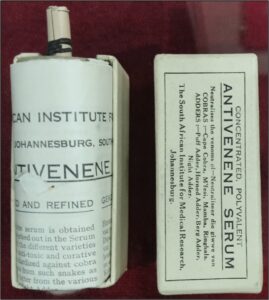
Anti-venom. (Picture: DNMMH).
The South African Institute for Medical Research had a serum department dedicated to developing a variety of snake bite antidotes. Since an antidote for one snake would be ineffective against the venom of a different type of snake, the serum department began to develop antidotes that could treat multiple species. The pictured antidote worked for the Cape Cobra, Mozambique Spitting Cobra, Mamba, Ringhals, Puff Adder, Horned Adder, Berg Adder, and Night Adder. To enhance potency, the serum department over-immunized horses. Their effectiveness was then tested on rabbits and sheep before being administered to humans.